
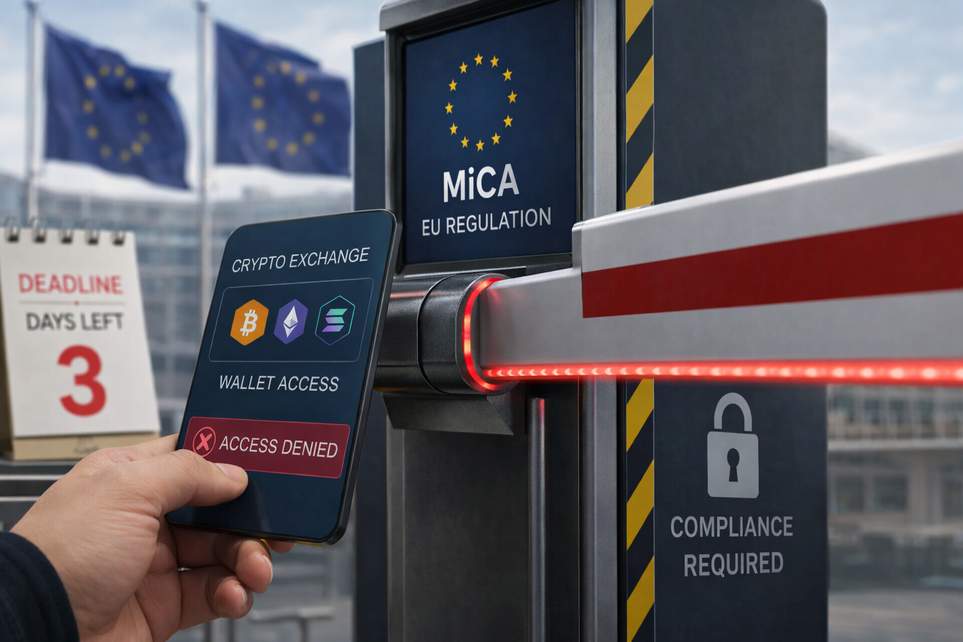
Millions of EU Crypto Users Face Exchange Cutoff as MiCA Deadline Looms
What’s happening on July 1?
On July 1 the temporary permission that has let many crypto platforms keep serving EU customers without a full MiCA license disappears. In plain English: if a company hasn’t already secured a proper MiCA authorization, it legally can’t offer services to people in the EU after that date. Getting a license isn’t a quick checkbox — it usually needs months of review by a national regulator — so for a lot of firms the clock has already run out.
To give you a sense of scale: regulators counted only a few hundred firms with full MiCA approvals while thousands of companies were registered across Europe before the new law. Industry estimates suggest many of the older, smaller operators won’t be able to keep serving EU customers once the grace period ends.
MiCA was written to raise the bar on consumer protection and market safety, but the immediate side effect is blunt: platforms that failed to qualify now face either an orderly wind-down, handing customers to a licensed cousin, or an exit from European markets altogether.
What this means for users and the market
How much you’ll notice depends on the platform you use. If your exchange has a MiCA license or operates through a licensed EU arm, things should keep humming along as before. If your provider is shifting customers to a licensed sister company, expect emails asking you to accept new terms and redo identity checks — regulators want full identity and AML checks to travel with users.
Platforms that don’t have a license will likely stop taking new deposits and will urge customers to withdraw funds or move them to a licensed service. That’s the polite version. In some countries, the response will be much tougher: French authorities have warned unlicensed firms they must quit offering services from July 1, and have threatened public blacklists, court actions, website blocks, and even criminal penalties.
Most everyday users won’t run into legal trouble — the risk falls on the platforms — but you should be proactive: a working app or a shiny website doesn’t equal permission to serve EU customers. The safest route is to verify whether your provider is on the official national or EU lists of licensed crypto firms.
There’s an awkward economic consequence too: compliance is expensive. The lawyers, capital and staff required to meet MiCA favor big banks and well-funded exchanges, which means smaller operators are more likely to drop out. That naturally concentrates trading and custody services into far fewer hands — fewer choices, more institutional players.
MiCA promised a single European market where one license lets a firm operate across all member states. But licenses are still handed out by 27 national regulators, and they haven’t moved at the same speed or with the same rigor. That opens the door to license-shopping — firms seeking the most lenient regulator — and raises questions about whether the new regime really creates a uniform market or just a patchwork of different speeds and standards.
We’ve already seen this ripple through stablecoins: major platforms removed a widely used stablecoin that didn’t meet MiCA rules while keeping compliant alternatives available, and issuers that wanted access to Europe either adapted or partnered with compliant local providers. Expect similar sorting across exchanges and brokerages now.
Keep an eye out in the coming days for obvious signals: big exchanges switching to new European arms, regulators publishing warnings or blacklists, services being restricted in countries like France, Spain, Italy or Germany, last-minute approvals, and the inevitable flood of emails telling users to withdraw or accept account transfers. Those messages will be the clearest clues about how the market is reshaping itself.
Bottom line: MiCA is trying to make crypto safer for European users, but the immediate effect will look messy — some platforms will vanish, others will shuffle customers around, and users will need to be slightly paranoid and a lot proactive until the dust settles.
