
Cipher Digital Sells 1,619 BTC at $47M Loss Ahead of AI Data-Center Rent
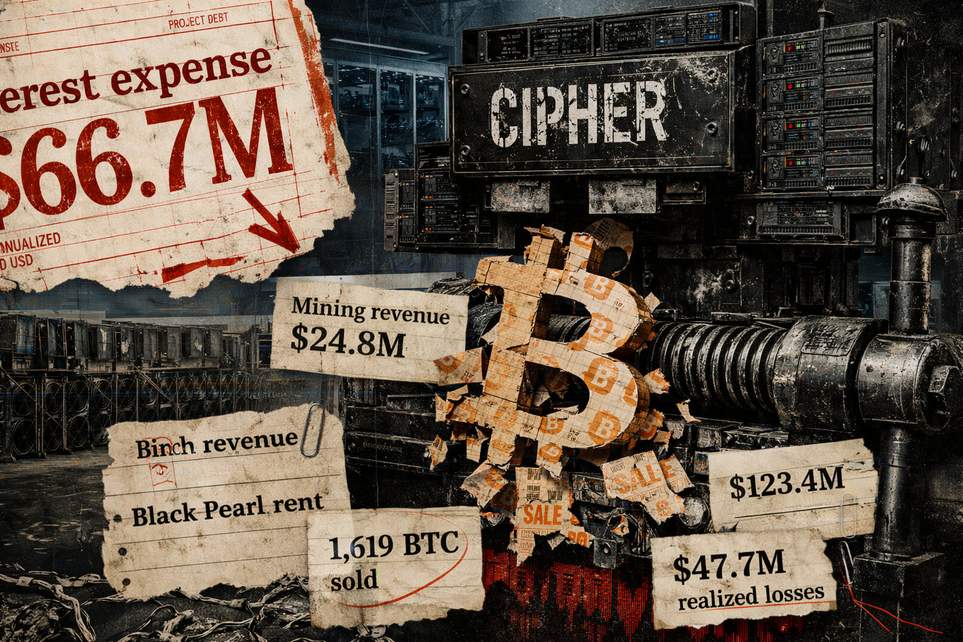
Cipher Digital pulled a move that sounds like it belongs in a heist movie but was really just accounting: it sold 1,619 Bitcoin and took a realized hit. The sale brought in about $123.4 million, but when the dust settled the company booked roughly $47.7 million in losses. Ouch — but also, welcome to public-company life.
The sell-off and the money drama
Numbers time: Cipher recorded $24.8 million in mining revenue while interest costs clocked in at about $66.7 million — roughly 2.7 times the mining take. By June 30 the firm still held 646 BTC (about $37.8 million at that snapshot). Quarterly mining revenue slid compared with the prior year (it was around $43.6 million a year earlier), and the second quarter carried roughly $23.5 million of that realized loss.
Operations chewed through cash in the first half of the year — about $152 million used in running the business — while the company poured roughly $964.3 million into property and equipment. The 1,619 BTC sale brought in $123.4 million, but financing was the real cash engine: net proceeds from financing were about $2.84 billion, which included $129.2 million from at-the-market stock sales. The filings aggregate cash flows at the company level, so it’s not possible to pin the Bitcoin-sale dollars to a specific project on the balance sheet.
On the balance-sheet front, Cipher reported around $831.8 million in cash and equivalents plus about $3.73 billion in restricted cash (money that can’t be used for general corporate purposes). Black Pearl project notes of roughly $2 billion are held by project entities and are secured; the parent company still carries some construction-completion exposure and the usual recourse carve-outs. A noncash warrant charge of about $150.5 million pushed the quarterly net loss to roughly $267.5 million. And yes, some warrants were issued related to a separate Barber Lake lease, which is accounted for separately from the Black Pearl project.
Black Pearl, rent, and what comes next
The company’s second-quarter revenue came entirely from Bitcoin mining operations at Odessa. The rent clock for the Black Pearl data center didn’t start until after June 30, but Cipher says it began delivering initial Black Pearl capacity at the start of August — two months ahead of schedule — and rent was already running by the time of the early-August update. That’s progress, but Cipher didn’t disclose how much rent it has actually collected or a quarter-by-quarter ramp schedule, so it’s hard to judge how much of their recent financing and coin sales were driven by the new data-center cash flow versus other needs.
Quarter three will be the first to show Black Pearl rent in the books, and that number — together with ongoing interest costs, continued buildout spending, and any further Bitcoin sales — should make it clear whether the company’s funding pressure eased or kept grinding. Other business lines also showed movement: HPC leasing pulled in about $31.9 million in the quarter as the company spent to expand data-center capacity. Meanwhile, broader items like grid reviews and power agreements could still reshape how miners build AI pipelines and how attractive those builds are from a financing and operational perspective.
Short version: Cipher is juggling heavy capex, a big financing stack, some painful accounting hits, and a new AI/data-center rent stream that finally starts to show up in results. It’s messy, a little exciting, and exactly the kind of corporate drama that makes quarterly reports fun to read — if you enjoy spreadsheets and suspense.
