
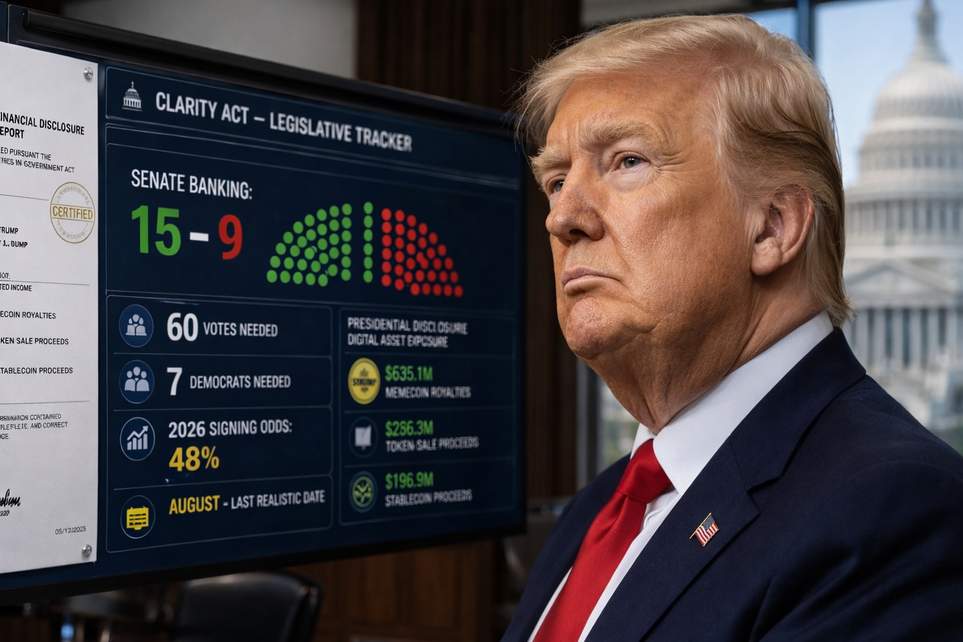
Trump’s Financial Filing Drops a Billion-Dollar Crypto Surprise into CLARITY Debate
President Trump’s latest financial disclosure (filed end of June and certified right after) landed like a confetti cannon at a quiet ethics meeting: loud, messy, and full of glittering numbers. The disclosure office gave the filing a stamp that it met reporting rules, after the campaign took a 45-day extension and paid late-filing fees for some previously unreported transactions.
A dizzying crypto balance sheet
The documents map a dizzying array of crypto positions across memecoins, NFTs, Bitcoin, Ethereum, staking, stablecoin ventures, DeFi tokens, governance tokens, and proceeds from token sales tied to a firm called World Liberty Financial. Think of it as a crypto buffet: cold wallets holding Bitcoin (north of $50 million) and Ethereum (estimates in the single-to-double-digit millions), stablecoin holdings in the multi-million range, plus staking rewards and trading-size token distributions.
One corporate line item stands out: license royalty income for a memecoin-branded project that shows up as well over half a billion dollars in royalties — the single biggest named dollar figure in the filing. Other entries include hundreds of millions from token-sale distributions and equity sales tied to a World Liberty Financial cluster, hundreds of millions more tied to stablecoin-related proceeds, and vast piles of governance tokens (the filing lists billions of tokens held by an affiliated entity).
There are also smaller (but still eye-catching) items: Ethereum staking validator rewards in the low millions, individual wallet distributions across several well-known DeFi token types, and a spouse disclosure reporting seven-figure proceeds from NFT and collectibles licensing.
Why this matters for the CLARITY Act
All this matters because lawmakers are trying to write the rulebook for the exact set of markets the filing exposes. The CLARITY Act — a federal bill intended to clear up how digital assets are classified and supervised — has powered through committee but still faces sticky ethics questions: should high-level officials and their families be allowed to hold, issue, or profit from the digital assets they’re simultaneously regulating?
Procedurally, the bill needs a supermajority on the floor, which means some cross-party votes are required. An amendment that would have barred the president, vice president, and members of Congress from participating in crypto businesses failed at the markup, and negotiators are still wrestling with whether ethics rules get baked into the main bill or handled separately. The Senate calendar — with an early July return and an August recess that many see as the last real shot this year — is tightening the timeline.
There are two easy-to-imagine outcomes. In the optimistic version, the disclosure gives defenders the talking point that the system worked: filing, certification, fees paid — move along, nothing to see. Congress narrows ethics language, or agrees to a parallel ethics deal, a handful of swing senators sign on, and CLARITY moves forward with a federal framework for digital commodities, DeFi clarity, and stablecoin oversight before election season ramps up.
In the less rosy scenario, the filing becomes Exhibit A for opponents: the sheer scale and variety of the holdings makes an ethics carve-out politically impossible to separate from market rules. If enough Democrats stay on the sidelines, the bill stalls and likely gets punted to a post-election Congress — meaning the whole effort restarts under a different calendar and math.
Bottom line: the disclosure both undercuts and fuels the ethics argument. Supporters will say transparency worked; critics will point to the size of what was disclosed as proof that transparency alone doesn’t solve the political problem. Either way, the CLARITY fight just got a lot more interesting — and a lot more spreadsheet-dependent.
