
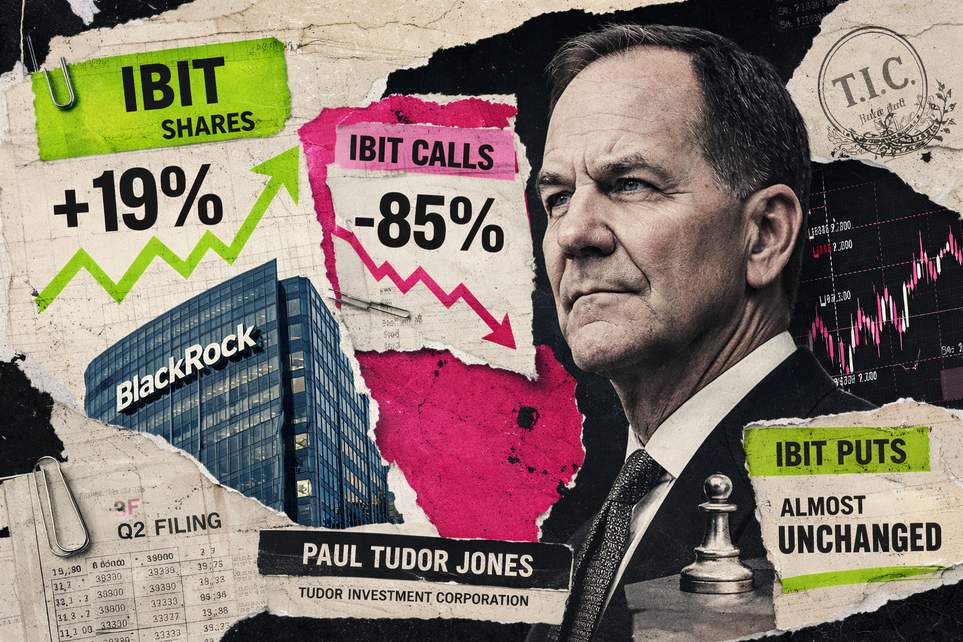
Institutional investor Paul Tudor Jones adds 109,446 BlackRock Bitcoin ETF shares while cutting calls by 85%
Quick snapshot: Tudor Investment reported more direct shares of BlackRock’s iShares Bitcoin Trust (IBIT) at the end of June, while the portion reported as call-equivalents plunged. The filing gives you neat numbers but not the full playbook—so yes, intriguing, but don’t start drawing bold conclusions yet.
The numbers (a spicy breakdown)
Between March 31 and June 30, Tudor’s reported direct IBIT holdings rose from 579,083 shares to 688,529 shares — an increase of 109,446 shares.
The call-equivalent line collapsed by about 85%, dropping from roughly 998,000 underlying-share equivalents to about 148,000. Meanwhile, the put-equivalent quantity barely budged, edging from about 725,000 to 715,000.
On a dollar basis (as presented in the filing), the direct IBIT shares were shown at about $22.9 million, the call-equivalent row at roughly $4.93 million, and the put-equivalent row around $23.8 million. At quarter end the put-equivalent entry was roughly 4.8 times the call-equivalent entry, whereas three months earlier the call row was larger than the put row by a factor of about 1.4.
What this actually tells us (short answer: not as much as you’d like)
Form 13F-style disclosures report option exposures in terms of the underlying security equivalents, not option premiums, strike prices, expirations, or the reasons the positions exist. In plain English: the table tells you how many shares-worth of exposure are being reported, but not how those exposures were built or why.
Important caveats: the filing omits many details — strikes, expiries, whether options are written or bought, account-level purpose, and any short equity positions that might offset things. The snapshot covers holdings as of June 30, so anything traded after that won’t show up. Add and subtract the rows and you still won’t have a reliable measure of Tudor’s directional Bitcoin exposure.
So while the move looks like more direct ETF shares plus far fewer reported call equivalents (and steady puts), that mix change could mean different things: de-risking, simple accounting/reporting shifts, rollovers into different instruments, or a genuine change in bias. The filing shows the “what”; the “why” stays mysterious.
Bottom line: neat data, fun to squint at, but don’t let the spreadsheet make you assume you’ve cracked the strategy. More detail would be needed to say whether Tudor is bullish, cautious, or just rebalancing in a way that makes SEC line items look dramatic.
