
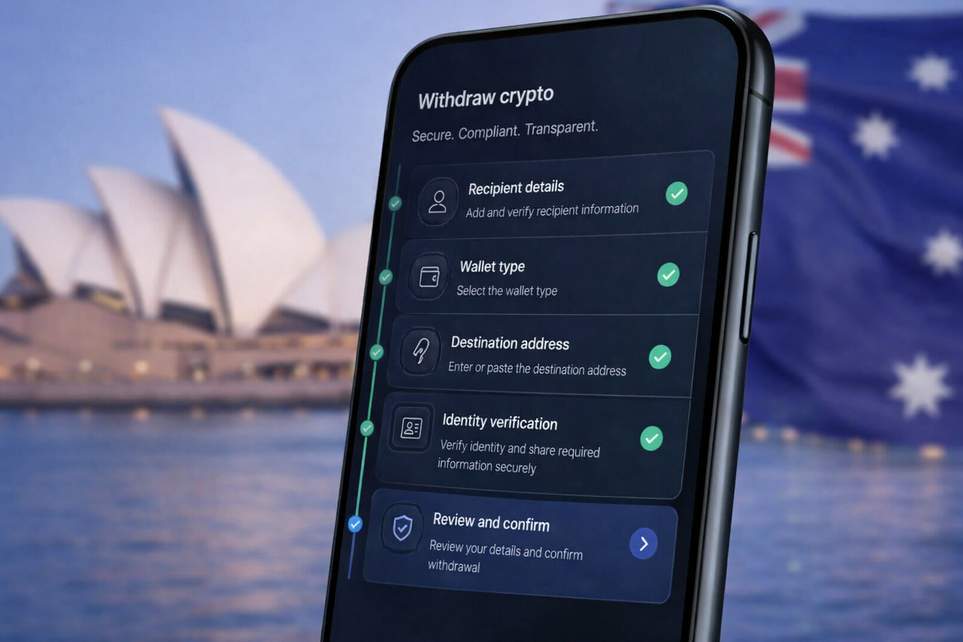
Australia’s July 1 Travel Rule: Why Your Exchange Withdrawal Just Got Nosy
What changed on July 1 (and why your withdrawal turned into a paperwork parade)
As of July 1, regulators in Australia flipped a switch: when a regulated crypto business accepts an instruction to move value, that instruction can trigger identity checks and a tidy heap of data work before the funds are released. In plain English: moving crypto through an exchange or other reporting entity is no longer just a blockchain transaction — it’s also a little data pipeline that needs to be fed.
That means exchanges and other virtual-asset service providers are now expected to collect and verify who’s sending, capture who’s receiving (full name please), classify wallets, check counterparties, route secure messages, and keep records linking payer, payee, wallets, and the transfer path. There’s no tiny-transfer escape hatch — the rule applies to transfers of any size unless a narrow exception applies.
Self-custody still exists, but it becomes more visible at the exchange border. Sending to a private wallet can exempt the business from passing info on to other firms, yet the regulated platform still often has to collect and verify payer and payee details and tracing data. Also, every time you press “send” and a regulated business accepts that instruction, a new set of obligations can kick in — repeat movements can create repeat data requirements.
What this actually feels like for users and exchanges
For users: expect more prompts, more fields asking who the recipient is, and occasional pauses while the exchange verifies info or decides whether the next stop on the transfer chain can securely accept transfer data. If you treasure privacy, the trade-off is clearer now: keep funds in self-custody to avoid the data checks, or use regulated venues and share more details.
For exchanges: the change is less a policy memo and more a product requirement. Firms need reliable workflows to gather and route transfer data at the moment instructions are accepted — not just manual reviews for big withdrawals. That means building or plugging in systems for wallet intelligence, transaction monitoring, secure message routing, and records management so the user experience doesn’t collapse into a flood of support tickets.
Operationally, this turns Travel Rule compliance into infrastructure: platforms must decide how to ask questions, when to pause a transfer, how to explain the request to users, and how to handle transfers to services that can’t accept transfer-message information securely. Expect to see new recipient-detail fields, wallet-ownership checks, longer review windows, and clearer explanations in withdrawal flows over the coming weeks and months.
The market response will be practical. Compliance vendors will likely get more embedded in withdrawal processes, exchanges will standardize deposit and withdrawal flows, and users will react in predictable ways — some will stash more crypto in private wallets, others will accept extra data-sharing as the price of convenience.
Bottom line: private crypto use in Australia remains possible, but the regulated edge around it now asks a second question before funds move — who’s involved, what kind of wallet is it, what information must travel, and can the transfer proceed safely under the anti-money-laundering framework. In short: your crypto can still leave the vault, but expect to be asked a few polite — and slightly nosy — questions first.
