
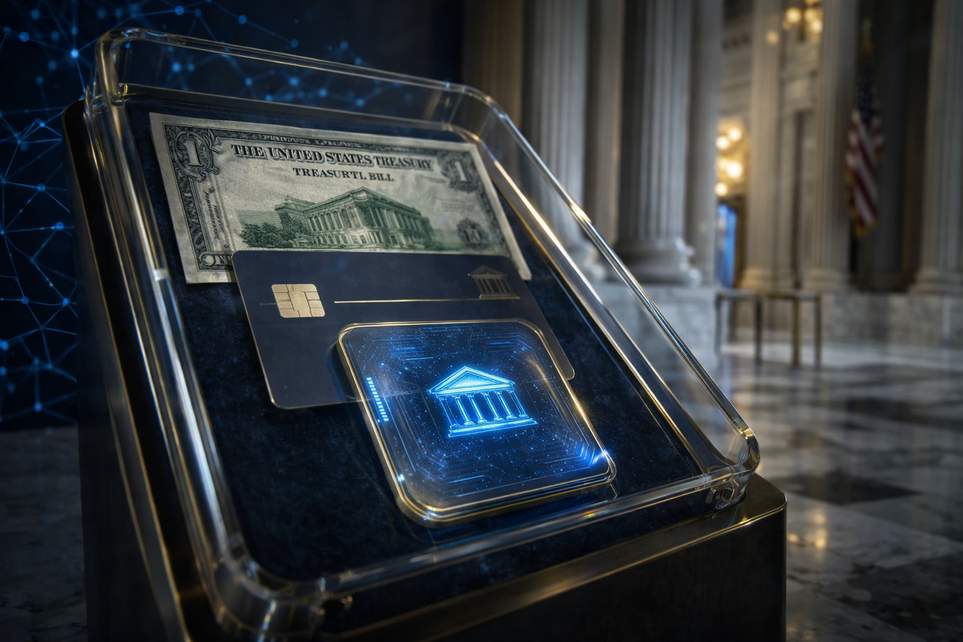
How Wall Street Quietly Turned Treasuries Into Onchain Collateral
Tokenized government paper used to sound like the sort of fintech talking-point you’d hear at 2 a.m. in a tech conference after-party. Fast-forward a bit: the idea isn’t vaporware anymore. Between tokenized money funds, onchain ownership records, programmable transfer rails, and efforts to make government debt act as usable digital collateral, the parts are coming together into something practical.
A surprisingly normal nine-figure Treasury onchain
Here’s the part that makes the whole thing feel real: a tokenized short-term Treasury product recently showed about $407 million in assets and a quoted yield around 3.45% APY. The same vehicle reported that roughly $222 million of its tokens live on one blockchain and about $185 million on another. It also imposes a $5,000 minimum for instant moves and restricts participation to accredited investors and qualified purchasers.
That matters because it’s not a toy — it’s a regulated vehicle with subscription rules, compliance gates, and an actual balance sheet. The fund even holds large stakes in other digital Treasury-style products, including roughly $150 million in a liquidity sweep fund, $101 million in a BlackRock-linked product, $77 million in a Franklin Templeton offering, and about $69 million in a Fidelity treasury fund. When tokenized funds invest in other tokenized funds, you stop looking at scattered experiments and start seeing the bones of a tradable market structure.
Why this matters — and what it doesn’t fix
Stablecoins handled fast, programmable dollar exposure, but they didn’t give digital markets the sort of trusted, yield-bearing collateral institutions prefer. Short-duration government instruments are already the go-to collateral in traditional markets: familiar, low-risk by market convention, and easy to price. Tokenization is trying to make that same paper easier to move, verify, and plug into software without stripping away the legal protections institutions require.
But don’t confuse a token’s slick interface with a free pass on legalities. The token is often just the digital wrapper — the actual investor rights still live in the underlying fund documents and relevant laws. Regulatory guidance has been clear that how a token is treated depends on what it represents. So access controls, transfer limits, administrator oversight, and investor accreditation are all part of the design. Institutions need to know who they’re dealing with and what happens in a stress scenario before they’ll commit real capital.
Also: big onchain asset totals aren’t the same as effortless liquidity. A fund can show a nine-figure number on a public page and still face narrow secondary markets, gated redemptions, or concentrated holders. The category’s growth is meaningful because it’s building usable plumbing — not because it magically solved every liquidity or legal question overnight.
Bottom line: tokenized Treasuries aren’t a revolution in government issuance; they’re a cautious, sensible retrofit. That conservative approach might be precisely why these products are getting traction — they bring familiar reserve assets onto more agile rails while keeping the legal scaffolding that institutions trust. It’s progress, not hype, and the next few quarters will show whether this becomes plumbing everyone actually plugs into.
