
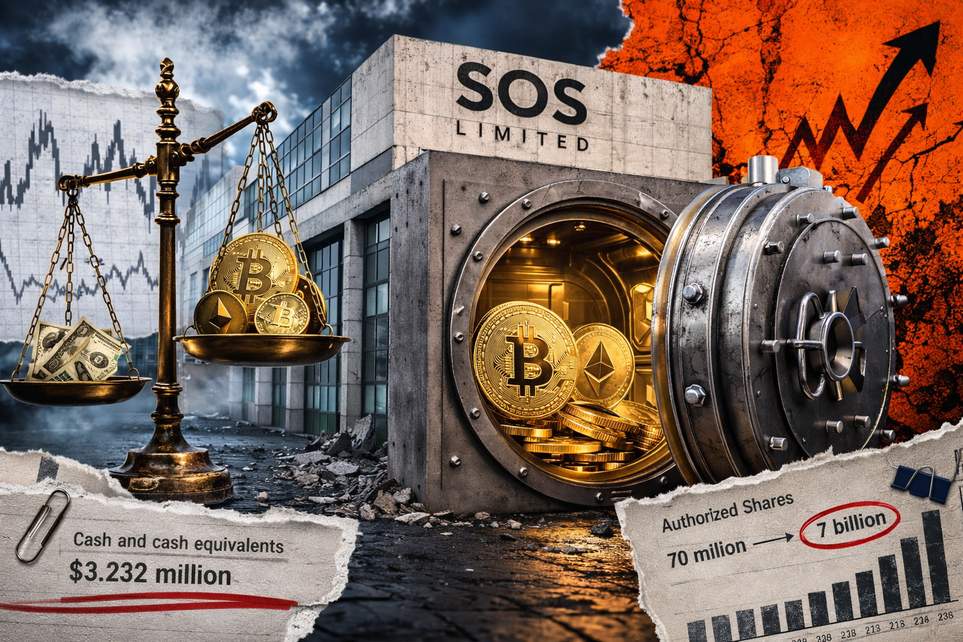
Zero mining revenue and a 98% cash wipe — SOS’s 7 billion share makeover and 2 million mystery shares
Big share pool, skinny wallet
SOS Limited just got shareholder approval to massively expand its authorized share count — think 70 million to 7 billion. That change only creates the room to sell stock; it doesn’t actually issue anything yet. The company would still need to finish some internal reorganizing and charter updates before any new shares hit the market, and the terms of future sales haven’t been disclosed.
Why the rush for more shares? At the end of 2025 the company was running on fumes: cash and equivalents collapsed from about $228.1 million to roughly $3.2 million. Most of the liquid value on the balance sheet is now in digital assets — about 802 Bitcoin and 2,949 Ethereum valued at roughly $70.3 million and $8.8 million respectively at year-end.
The awkward financial highlights — and a mystery allotment
2025 was a rough year. SOS posted a net loss of about $97.3 million from continuing operations. Direct revenue from crypto mining went from $9.2 million in 2024 to zero after the company paused that activity. Hosting services brought in around $7.5 million and the firm took roughly $5.8 million in impairment on mining equipment.
Here’s the eyebrow-raising part: between the company’s May 15 report and the July 13 record date, the number of outstanding Class B shares rose by exactly 2 million while Class A stayed the same. There’s no public, transaction-specific disclosure explaining who got those 2 million Class B shares, what was paid, or why. If the filings are accurate, those shares appear to have been issued without a public explanation.
Shareholders also gave the board a two-year window to do one or more share consolidations (reverse splits), starting with a 1-for-2 and allowing up to a cumulative 1-for-20. That gives the board flexibility to tidy up the capital structure if they choose to use it.
What this could mean and what to watch
Expanding authorized capital is basically handing the company a big flashlight and a toolbox: it creates options for fundraising, acquisitions, equity pay, and other deals. But it doesn’t force dilution — the actual impact on existing shareholders depends entirely on whether the company issues shares, how many, and at what price and terms.
Key things to follow next: updated cash and crypto holdings (to see whether the liquidity squeeze eased or worsened since year-end), any filings that explain the mysterious 2 million Class B shares, and any actual share issuances or financing announcements using the enlarged pool. Until those pieces show up, the vote mostly just signals an easier path to raise equity if SOS needs it.
