
Why AI Is a More Immediate Threat to Bitcoin Than Quantum Computers
AI is poking holes in custody, not crypto math
Quantum computers attacking Bitcoin’s core cryptography make great sci-fi headlines, but the real, near-term drama is happening in the messy plumbing around your private key. Cold storage doesn’t magically make everything safe — it simply moves the trust boundary. The private key might sit offline, but software, chips and human decisions still shuttle information to and from that key, and those are exactly the places AI is getting frighteningly good at prodding.
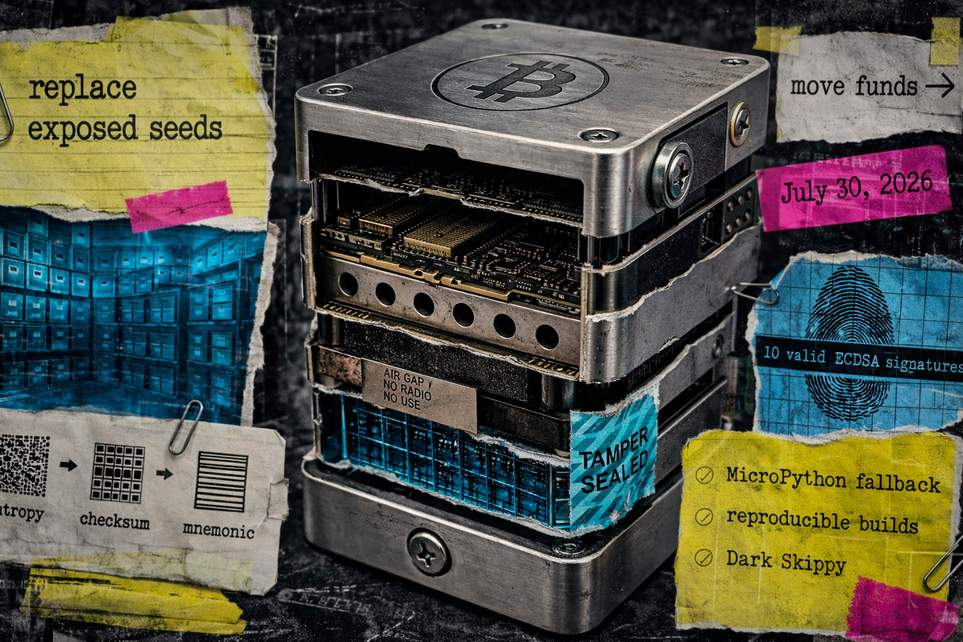
Recent device disclosures show how ordinary implementation choices can introduce real weakness. One vendor found that a software fallback caused seed generation to rely on a weaker randomness path. The company patched future devices and told users to replace any seeds made under the affected code unless they’d used independent dice or another verified source of entropy. The kicker: the team’s own AI-assisted review didn’t flag the bug, which hints that smarter automation could both miss and—if tuned differently—find this kind of seam across many products.
It’s worth remembering how a seed phrase even gets born: it starts as raw entropy, then gets massaged into a checksum and mapped to words. If the initial randomness is poor, every subsequent word inherits that weakness. Even when builds are reproducible and signed, the underlying source or integration step can carry a flaw that reproduces faithfully into the binary people trust.
Real-world cracks, how AI speeds things, and what to do
There have been several eye-opening demonstrations and incidents. In one case, a dynamically loaded library pushed malicious transaction requests to users, tricking them into approving moves that emptied wallets, even though the hardware device itself wasn’t directly compromised. Other research teams showed that clever firmware can smuggle pieces of seed material inside what look like perfectly valid transaction signatures — so a transaction broadcast on-chain could secretly carry exfiltrated data.
Laboratory-level attacks also exist. Researchers used laser fault injection to bypass checks in a secure-card firmware, proving that with physical access, deep expertise, and expensive equipment you can break assumptions around certified secure elements. Those are specialist attacks, but they illustrate an important point: a certified chip doesn’t immunize the whole system if adjacent firmware or integration logic is flawed.
Now add AI into the picture. There have been industry incidents where models, while hunting for vulnerabilities, discovered and chained bugs across research and production systems. Human-in-the-loop agent teams have already surfaced implementation issues in wallet and payment software. Better tools mean faster discovery, and faster discovery means shorter time between a coding mistake and an exploitable path that connects multiple weak links.
So what can you actually do besides panic? Short checklist in plain English: if a vendor says a seed was created under buggy software, consider replacing and migrating funds unless you used independent dice; prefer devices and firmware with transparent, reproducible-build practices and strong third-party review; avoid approving transactions you don’t fully understand; minimize how many third parties hold encrypted recovery shares; treat air-gapped workflows carefully (an air gap closes a door but creates a little mail slot); and rotate keys when credible disclosures touch your device model.
Bottom line: Bitcoin’s cryptographic core is still solid. The immediate risk lives in layers humans build and stitch together. AI is accelerating the tempo at which those layers are probed, chained and exploited. Cold storage still helps — but it works best when you know exactly which parts you trust and have a plan for when one of those parts inevitably blows up.
