
American Bitcoin Pledges Nearly 40% of Its BTC Toward Mining Gear — What That Actually Means
The snapshot: reserves, pledges, and who’s behind it
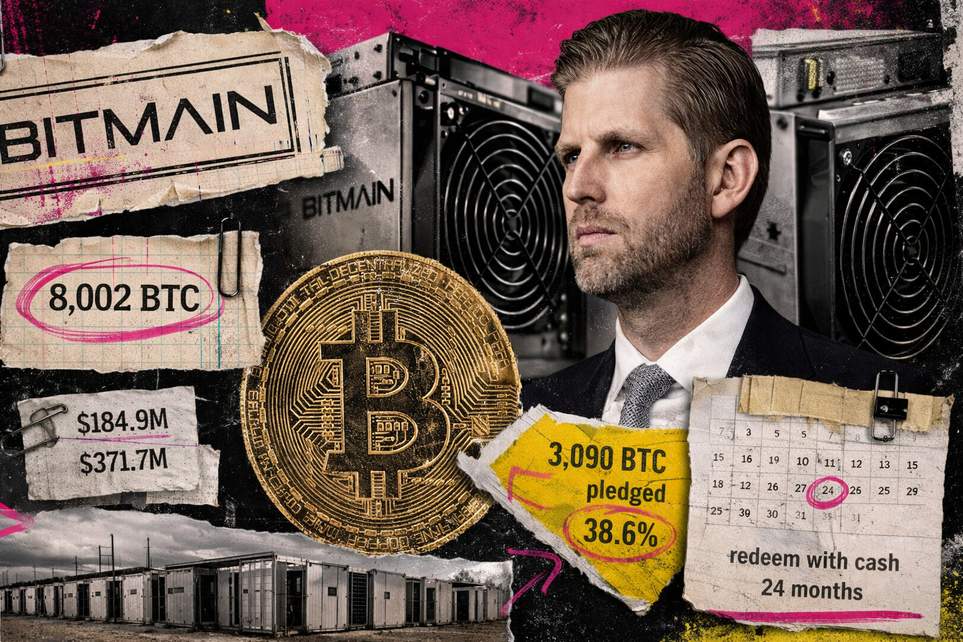
American Bitcoin closed June with 8,002 BTC on its books. Of that stash, 3,090 BTC — roughly 38.6% — has been earmarked for buying mining rigs from Bitmain. The rest, about 4,912 BTC, isn’t tied to those purchase pledges and sits unpledged on the balance sheet.
The company launched in 2025 in a partnership between Hut 8 and American Data Centers, with backing from Eric Trump and Donald Trump Jr. At the outset, Hut 8 owned around an 80% stake, and Eric Trump was listed as co-founder and chief strategy officer.
How the miner pledges and redemption windows actually work (and why the numbers look weird)
Most of the pledged coins came from several tranches in 2025 that together added up to 2,776 BTC. Each tranche generally comes with a redemption window of about 24 months from the date it was pledged. In short: the timing of those windows — not day-to-day Bitcoin price swings — dictates when the company must decide whether to keep the coins or use them to pay for hardware.
One separate February 2026 deal covered 11,298 miners priced at roughly $49.4 million. For that contract, American Bitcoin put up 314 BTC to cover 80% of the price. The remaining 20% becomes due a year after shipment and can be paid in cash, in Bitcoin at a pre-agreed floor price, or a mix of both. That 314-BTC commitment also has about a 24-month redemption window and an option to extend another 12 months.
Because American Bitcoin retains redemption rights and economic exposure, the pledged coins still show up on the balance sheet until a redemption window lapses and the coins are actually applied to equipment purchases. If the company pays cash before the window closes, it keeps the coins; if it doesn’t, the pledged BTC is handed over for the miners and removed from the balance sheet.
The company’s filing puts a carrying value of $184.9 million on the pledged Bitcoin as of June 30, while it also records a $371.7 million non-current miner-purchase liability tied to the purchase and redemption agreements. Those two figures are measuring different things — the first is a snapshot of fair value at quarter end, the second is the accounting treatment of contractual purchase obligations — so they shouldn’t be treated as a simple loan-to-value ratio or an immediately payable shortfall.
To give a quick market-flavored example (and yes, it’s just an illustration): if Bitcoin trades somewhere near $62,600, that pledged pool would be worth on the order of $193 million and the unpledged 4,912 BTC would be worth roughly $307 million. But remember: market spot values at a later date aren’t the same thing as the accounting values reported as of June 30.
The Q2 results also showed a GAAP loss of $57.2 million, which included a $71.2 million digital-asset loss, an $18.3 million derivatives gain, and $28.2 million of depreciation and amortization. Those accounting entries don’t directly describe the company’s cash-on-hand.
Speaking of cash, American Bitcoin raised about $33.6 million net by selling 2.15 million split-adjusted Class A shares through an at-the-market program. Shares outstanding ticked up roughly 3% quarter over quarter; on the holdings side, their Bitcoin stash grew about 14% and satoshis-per-share rose around 11%.
Bottom line: the pledges tie a big chunk of the company’s BTC to future hardware purchases, but the timing and ultimate outcome depend on those redemption windows and management’s choice to pay cash or let the coins settle into miners. Accounting lines can look dramatic, but they’re often just the bookkeeping side of a multi-year equipment-for-coin dance.
And yes — it’s a little odd, a little financial theater, and mildly suspenseful: watch the redemption clocks more than the price ticker if you want the drama.
