
Bitcoin futures carry briefly tops two-year Treasuries as ETFs keep buying
What happened (in plain English)
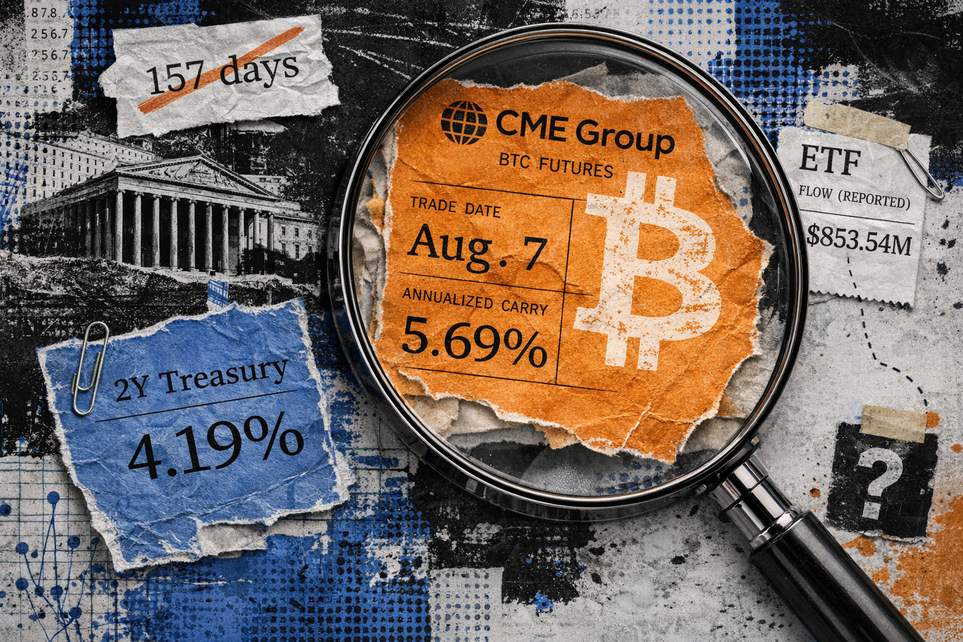
On Aug. 7, an odd little wrinkle showed up in the markets: the gross annualized premium on certain Bitcoin futures — the so-called carry or basis — was higher than the two-year U.S. Treasury yield. In plain talk, some futures contracts were offering a bigger annualized return than a two-year government IOU. The headline number that stole the show was the August futures contract, clocking about 7.89% gross annualized basis on that date. September read around 6.25% and December about 5.69%.
For context, the two-year Treasury par yield that day was roughly 4.19% (and ticked to about 4.25% a few days later). A matched-date check using the CME settlement numbers alongside a 4 p.m. New York Bitcoin spot benchmark (about $64,880 on that date) produced these readings — meaning the comparison used the same market snapshot for both spot and futures.
Some market watchers had been tracking a streak where Bitcoin futures carry trailed the Treasury benchmark for months. That long run of underperformance was interrupted by the Aug. 7 snapshot, though the exact result depends on which venue, roll rule, or time series you pick. Small changes in methodology can flip the narrative — welcome to finance, where details matter more than the headlines.
Why traders care — and why it’s not a free lunch
The classic cash-and-carry arbitrage looks simple: buy the spot asset, sell the futures, and pocket the premium as prices converge. If futures are trading above spot, that premium can be annualized into a tempting percentage. But reality brings invoices: financing the spot leg, posting margin, paying fees, funding costs, and execution slippage all chew away at that headline number.
On paper, a futures basis that beats a Treasury yield sounds like a riskless profit. In practice, it’s peppered with risk. Studies of crypto carry have shown one-month Bitcoin carry rates topping 20% at times, but those spikes came with leverage, margin calls, and liquidation risks that could blow up positions before convergence. For an institutional arbitrage desk, the real question is the net spread after funding, balance-sheet costs, and execution — not the raw gross number.
There are also measurement quirks. The CME’s BasisWatch-style approach typically uses the 3:59–4:00 p.m. time-weighted average for spot and the nearest monthly futures price at 4:00 p.m., plus a defined roll convention. If you change the time window, the settlement series, or the contract chosen, the annualized basis can shift noticeably. So one analyst’s streak-breaker may be another analyst’s footnote.
Meanwhile, U.S. spot Bitcoin exchange-traded products continued to attract money. The week ending Aug. 7 saw about $853.5 million of net inflows into U.S. spot Bitcoin ETFs. July’s aggregate inflows were roughly $172 million, though individual days — for example July 21 — could be much larger (around $200 million in that single day). These ETF flows record cash entering the products but don’t reveal whether that spot exposure was paired with short futures as part of an arbitrage setup.
Regulatory reporting like CFTC trader categories shows aggregate long and short positions by participant type, but these datasets don’t connect an ETF purchase to the specific futures short that might hedge it. In short: we can see the pieces, but not which investor holds which combination.
If cash-and-carry demand were truly reappearing in force you’d expect three things to occur together: the futures basis would settle at a funding level that survives financing and execution costs, ETF net inflows would keep coming as the spread stays wide, and CME open interest plus trader positioning would show more short futures usage. Seeing all three in concert would be a reasonable sign that arbitrage desks are deploying capital. Seeing only one or two is suggestive but not definitive.
Finally, remember price and carry can tell different stories. Bitcoin’s price may climb because of pure directional buying even while the carry remains unattractive to arbitrageurs. The more useful institutional measure is the net basis after funding costs, viewed alongside ETF flows and futures positioning — not any single stat waved around on its own.
So yes, Aug. 7 produced a neat chart-topper: headline carry above two-year Treasuries for certain contracts. It’s an eyebrow-raiser, not a smoking gun. If you want this trade to be a reliable source of returns, you’ll need to account for the pesky real-world costs and risks that turn flashy numbers into actual profits — or losses.
