
Cardano vs Solana: Two Ways Governance Trips Over Its Own Feet
Cardano’s “If you don’t show up, tough luck” problem
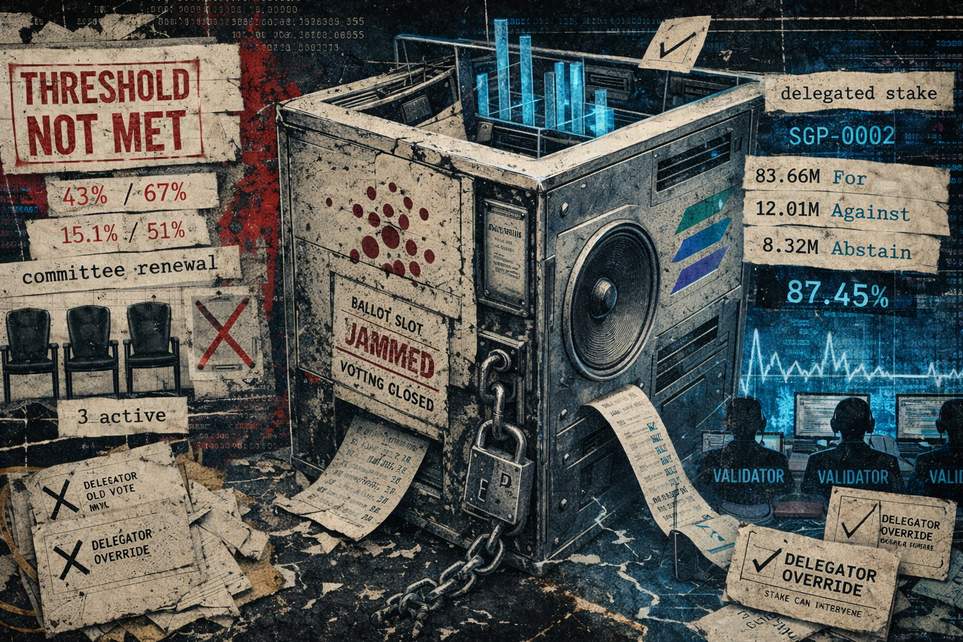
Imagine a party where two separate groups must both RSVP “yes” or the cake gets thrown out. That’s essentially how Cardano set up one of its governance votes: two different camps — delegated representatives (DReps) and stake pool operators — each need to meet their own approval bar for a committee renewal to go through. If one group underperforms, the proposal dies, even if the other group is enthusiastic.
Late in August, a snapshot of the vote showed a pretty big no-show problem: DRep backing sat well under the required supermajority, and stake pool operators were even further behind their threshold. There’s a hard calendar consequence here: several committee terms are due to expire around the start of September. If replacements aren’t authorized in time, the committee could shrink below the minimum size needed to approve certain governance actions.
Before you panic and think the chain will freeze — it won’t. Blocks will keep being produced. What would be affected are the committee-only approvals and the timing of upgrades that rely on that committee to sign off. In short: it’s a governance bottleneck with real scheduling headaches, born entirely from voter apathy and a design that refuses to let one group rescue another.
Solana’s “I’ll vote for you unless you tell me not to” trade-off
Solana solves low turnout with a very different shortcut: validators can cast governance votes using the stake that people have delegated to them — unless those delegators explicitly override. That sounds efficient (less coordination, fewer meetings), but it shifts the work to a different kind of vigilance: keeping tabs on the validators you trust with your tokens.
A late-August governance snapshot of a disinflation proposal showed a large chunk of SOL recorded as voting For, with a much smaller Against and some Abstain. Only a few hundred delegators actively used the override option, which means most of the voting weight came from validators acting on behalf of silent holders. That’s fine if validators vote in line with their delegators’ wishes, but it gets awkward when validators have obvious financial skin in the game.
Case in point: a publicly traded treasury firm that holds and stakes SOL announced opposition to the timing of the policy — and staking makes up almost all of that firm’s recent revenue. That doesn’t prove foul play, but it does highlight the potential conflict: validators (or big treasury actors) might vote in ways that protect their income, and passive token holders would need to step in manually to stop that.
To make things messier, the rules for what counts as “passing” can be read a couple of different ways in the docs. One source says a quorum (one-third of stake) plus a two-thirds majority of participants is needed; another says there is no quorum and the metric is just two-thirds of For vs. For+Against. That ambiguity turns a clear vote tally into a soap opera until the rulebook gets reconciled.
So which is worse? Cardano’s approach makes the cost of doing nothing painfully obvious — miss the deadline and committee capability gets hamstrung. Solana’s approach lowers that immediate risk by letting validators speak for you, but it places the burden on delegators to watch their validators or accept whatever choices those agents make.
Bottom line: both blockchains expose the same nasty truth from opposite sides — on-chain governance only works so long as people actually care enough to participate. Cardano’s problem is immediate and calendar-driven. Solana’s problem is longer-term and about representation and incentives. The next votes will tell whether either chain can motivate its people to show up, or whether governance will keep tripping over the same two banana peels: lazy tokenholders and conflicted voters.
