
Pyth API shake‑up could freeze unpatched smart contracts across hundreds of DeFi apps
What changed (and who needs to panic a little)
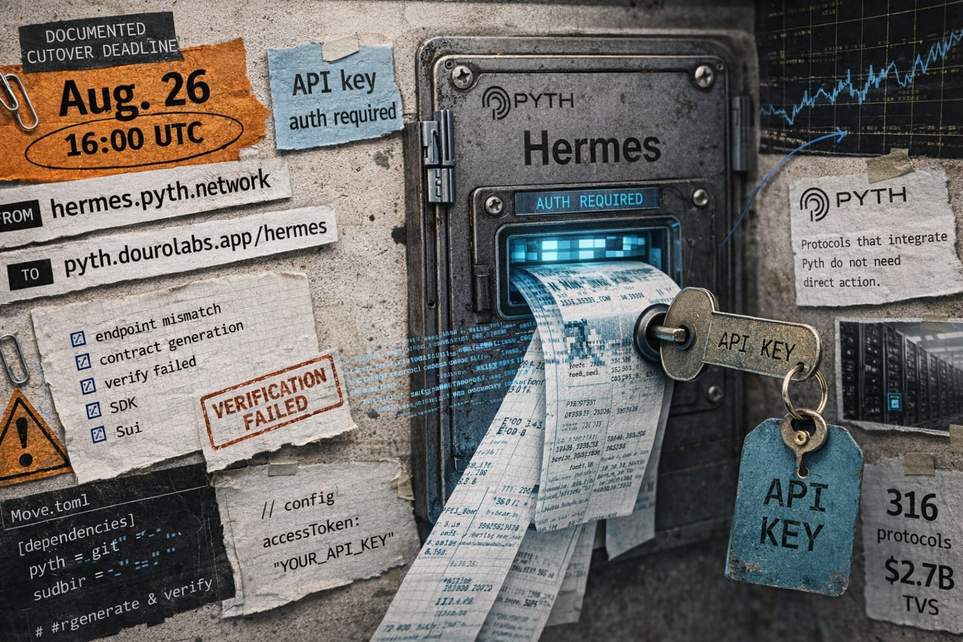
Yesterday Pyth rolled out a backend upgrade for its Hermes price service and flipped on an authentication requirement: direct callers now need an API key to fetch prices. The old hermes.pyth.network address is being routed to the new backend, and if your app still pulls data from the legacy setup without supplying a key, those requests can get rejected.
This isn’t just a small dev annoyance. A live oracle mapping points to Pyth being used by roughly three hundred-something DeFi projects (a snapshot showed about 316 integrations and a few billion dollars of value tied to those integrations). If apps don’t update how they talk to Pyth — endpoint, SDK and the on-chain contract generation all synced up — price updates can fail to authenticate or fail verification on-chain.
Why this can break stuff (and what to do about it)
In systems that use a pull-style oracle (where your app fetches a price and then posts it on-chain), two things can go wrong: the client attempting to fetch prices might be refused because it lacks the new API key, or it might get data from an endpoint that doesn’t match the contract it uses to verify updates. Either way, the app’s price-update transactions can hang or be rejected until the configuration is corrected. Translation: contracts that weren’t updated may stop receiving verified price updates and could effectively freeze price-dependent actions.
Some platforms—Sui in particular—couldn’t be auto-swapped to the new package because on-chain packages are referenced by an unchangeable object ID. That means Sui developers have to update two things manually: the client that requests prices (pointing it at the new Hermes endpoint and passing the access token) and the on-chain Move package dependency to the new revision in Move.toml. If your client code can’t accept an access token in its constructor, it’s time to modernize that client.
So far there weren’t widespread reports of money lost or universal outages right after the cutover, but the real test is practical: can direct callers authenticate? Do the endpoint, SDK, and the contract generation all match? If any one of those is out of sync, expect stalled updates until fixed.
Practical checklist for developers: 1) Ensure your Hermes requests include the required key (as a bearer token or SDK token). 2) Confirm you’re hitting the upgraded endpoint and not an old URL. 3) Rebuild or regenerate any on-chain contract artifacts so they match the upgraded price payload format. 4) If you’re on Sui, update your Move.toml dependency and point SuiPriceServiceConnection (or equivalent) to the new endpoint with the token. 5) Test a full end-to-end price-update flow on a staging network before touching mainnet.
In short: it’s a classic ops puzzle — not dramatic if you prepare, painful if you ignore it. If your project relies on Pyth and hasn’t checked its keys, endpoints and contract generation lately, slide that task to the top of the sprint board.
