
Your AI Bank Account Could Be Making Loans Pricier (No, Really)
Why fast-moving, AI-directed deposits actually matter
Imagine your checking account as a couch potato: it sits at one bank for years, collects a little interest, and the bank uses that steady cash to fund long-term loans like mortgages. Traditionally, deposits behave a bit like long-term funding because people don’t uproot them very often and banks don’t immediately match every market rate move on what they pay depositors.
Now picture that couch potato with a jetpack. Smart, agent-style AI and instant, token-like bank money could let customers jump their cash from bank to bank in milliseconds — driven by tiny yield differences or programmed rules. When deposits can move that fast, the “stickiness” that banks counted on starts to evaporate.
At the heart of this is how long deposits effectively last and how sensitive deposit rates are to market moves. If deposits become more rate-sensitive or shorter-lived — because automated tools shuttle money away at the first sign of a better rate — banks lose that quiet, long-duration funding advantage.
What that might mean for banks, loans, and your wallet
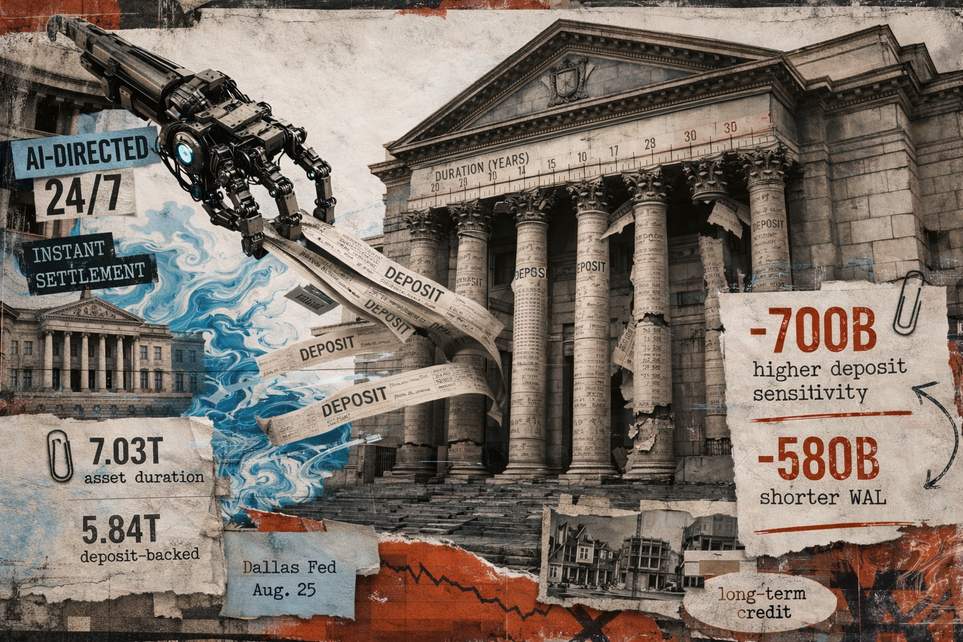
The Federal Reserve Bank of Dallas ran some back-of-the-napkin-style math on this and came up with eye-catching numbers. Using mid-July commercial-bank balance sheets and its own duration assumptions, they estimated roughly $7 trillion worth of asset-side interest-rate exposure measured in 10-year Treasury equivalents. About $5.84 trillion of that exposure relied on deposit behaviors other than big time deposits.
Translation: a lot of bank lending today is indirectly supported by deposits acting like longer-term funding. If deposits become less stable — either by becoming more responsive to market rates or by staying at banks for shorter stretches — that reduces banks’ tolerance for interest-rate risk and their ability to turn short-term deposits into long-term loans.
To give a sense of scale: in the Dallas Fed’s scenarios, a hypothetical 10% jump in deposit rate sensitivity (holding a four-year average life) cut collective duration-risk capacity by about $700 billion in 10-year equivalents. A separate hypothetical 10% shortening in the average life of deposits trimmed maturity-transformation capacity by around $580 billion. Those are model numbers, but they show how quickly capacity could shrink.
Banks have several playbooks to react. They could borrow more term wholesale debt to match longer loans, which tends to be pricier than stable deposits — and that extra cost usually trickles down to consumer and business loan rates. Alternatively, banks might pile up more cash and government bonds as a buffer against sudden outflows, which leaves less capital available for riskier, illiquid lending.
There are early clues that faster payment rails change bank behavior. Research from Brazil showed that heavier use of an instant-pay system nudged banks toward holding more liquid assets and doing less maturity transformation. It’s not a one-to-one comparison, but it signals that instant movement of funds can reshape how banks manage liquidity.
Bottom line: programmable, AI-enabled deposit movement is still young and uncertain, but if it scales up it could shrink the plumbing that helps fund long-term credit. That doesn’t mean your mortgage will spike overnight — it means banks may lean on more expensive funding or tighten lending, and those costs can eventually reach borrowers.
