
AI Data Centers Are Learning the Power Tricks Bitcoin Miners Figured Out First
Every time an AI answers you, a bunch of hungry silicon in a distant building just gobbled electricity and exhaled heat. Those chips don’t just think — they gulp power, move data, and demand heavy-duty cooling. Multiply that by millions of queries and suddenly your quick chat reply is a tiny miracle that made a substation sweat.
Why AI chips feel like tiny power plants (and why the grid panics)
Big data-center campuses can use as much electricity as a small city, and they can pop up faster than utilities can lay wires and install transformers. Building new generation and transmission is expensive and slow — think years and billions — so grid operators often face a timing mismatch: data centers want huge blocks of power now, while the grid needs months or years to catch up.
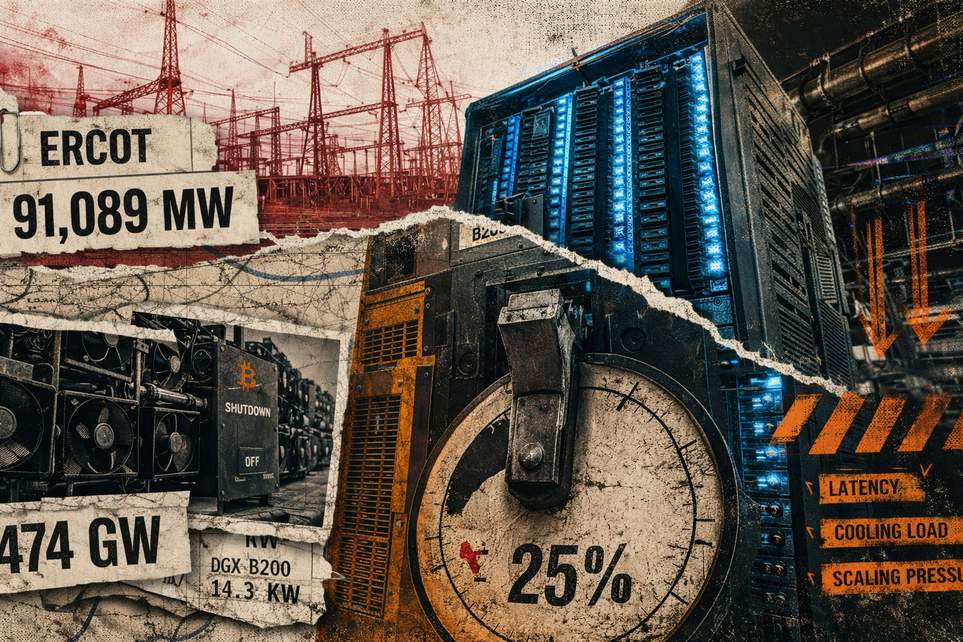
Texas is a nice example of this squeeze. The statewide grid has hit record peaks, and developers have asked to connect queues of proposed load that are enormous on paper — hundreds of gigawatts, much of it for data centers. Regulators have started auditing those requests because the list has grown divorced from what the physical grid can actually handle.
Meanwhile, a single modern GPU can draw a startling amount of juice. An individual high-end GPU can use on the order of a kilowatt and a whole server with several GPUs can be tens of kilowatts. Scale that to hundreds of racks and you’re rapidly talking about megawatts. Utilities design for steady city-sized loads, not sudden swarms of ravenous accelerators.
Throttles, experiments, and whether AI can learn to be polite
One way to close the gap is not to build your way out of the problem, but to time-shift the work. Not all AI tasks are created equal: some requests need instant answers, while training runs, background experiments, or bulk image processing can be nudged later. If software can sort urgent jobs from the loafers, a data center could temporarily slow or delay noncritical tasks when the grid is tight, then catch up when power is cheaper and more plentiful.
That’s not just theory. A small demonstration in Texas had a single high-powered AI chip — an Nvidia B200 — pulled down to roughly a quarter of its normal power draw in under a second. The work in progress wasn’t erased; it just completed fewer requests while throttled and sped back up afterward. That’s promising, but it’s also one chip. Scaling that trick to thousands of GPUs, racks, and whole buildings is a different kind of chaos.
There are precedents. Bitcoin miners have long participated in so-called demand response: when wholesale prices spike or the grid screams, miners can flip off machines and pick up where they left off later. That “shut down, restart, no customer waiting” model made miners useful as emergency brakes for the grid. The question is whether interactive AI services — where customers expect answers now — can inherit some of that obedient behavior without making users stare at loading spinners forever.
Cloud giants and researchers are already experimenting with sensible scheduling. Big players have shifted background video processing, indexing, and other non-time-sensitive workloads across regions or delayed them during local grid stress. Published experiments show useful results: clusters cutting 25–75% of power for controlled periods without violating service promises, and models suggesting that inference-heavy facilities might reliably offer tens of percent of flexibility. In grid models, that flexibility can reduce the need for new peaker plants or lower costs when networks are congested.
Still, the devil is in the details. Operators must know how much a site would have used otherwise, verify reductions with meters, and avoid creating a giant rebound spike when thousands of GPUs ramp back up. Customer contracts matter: whoever pays for instant response will expect instant response. A practical solution could be tiered service — interactive, near-real-time, and flexible batch — where customers trade lower cost for a willingness to wait.
Policy is trying to catch up too. Some places are starting to require large new users to be able to reduce consumption during severe emergencies, and billing schemes that reward shaving usage during a few peak windows have turned curtailment into a strategic game. Regulators are also debating alternatives that target peaks more accurately so flexibility shows up when the grid actually needs it.
The headline: a single chip that can be throttled fast is an impressive gadget trick, but data centers are ecosystems with cooling, networking, storage, and thousands of interdependent jobs. Making AI flexible enough to be an honest-to-goodness grid asset will take smarter schedulers, clear contracts, reliable measurement, and a lot more real-world tests. If it works, though, the next wave of AI growth could be powered as much by timing and clever software as by building new power plants — which would be a relief for grids everywhere, and good news for anyone who prefers their models served with a side of reliability.
