
Why your laptop AI might be a privacy-friendly sidekick — but not your wallet’s boss
Local AI on your laptop: getting surprisingly competent
Heads up: your laptop is getting smarter in a hurry. Recent improvements in local models and inference tools have pushed on-device AI from cute demo mode toward actually useful. One developer running a high-end laptop reported input processing speeds roughly in the low hundreds of tokens per second and output generation in the high teens to low thirties of tokens per second — enough to feel snappy for many everyday tasks.
How? New model designs let the system activate only a fraction of parameters per token, so huge models can behave more like nimble assistants instead of memory-hogging beasts. One experimental multimodal model family being tested uses a very large main parameter set plus extra embedding tables, while enabling only a smaller subset of parameters to run for each token. Pair that with optimized runtimes and quantized builds, and suddenly local inference becomes practical on well-equipped machines — provided you have the RAM to match.
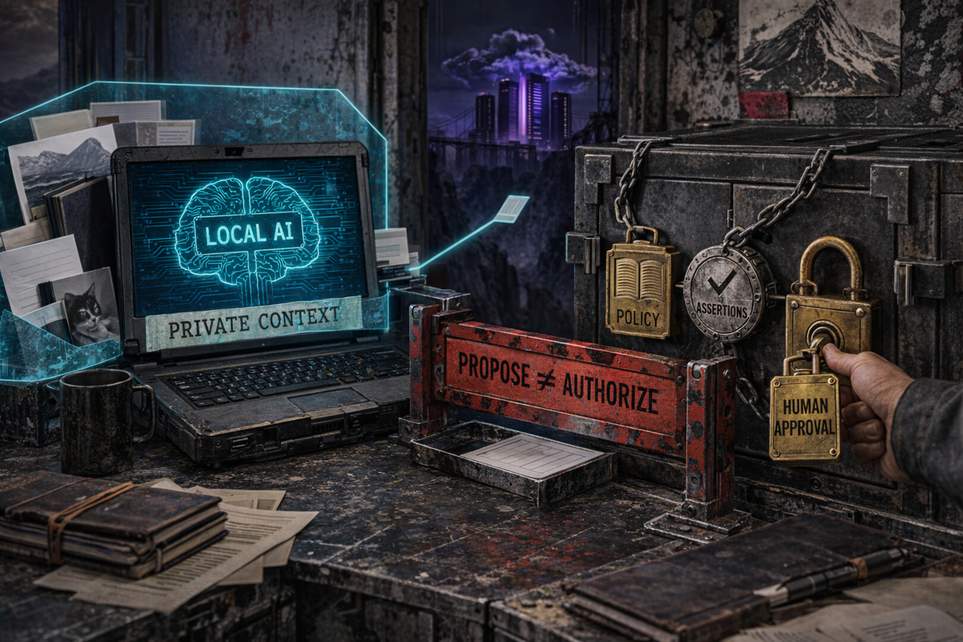
That doesn’t mean your laptop just replaced the cloud. In the most useful setups the local model acts as an intelligent gatekeeper: it handles the bulk of everyday work and only asks remote services for heavy lifting when strictly needed. That way, your computer keeps most of the private context to itself and sends only the trimmed-down question or snippet to the outside world. Faster, quieter, and less nosy — at least in theory.
Benchmarks and reports show real capability gains across knowledge, coding, reasoning, and vision tasks, and in some comparisons newer Flash-style variants outperform slightly older, larger models while using less active compute. But performance benchmarks rarely measure safety: resistance to prompt injection, the ability to ignore malicious instructions embedded in input, or the wisdom to refuse dangerous financial actions are usually outside those tests.
Protecting your crypto: controls, assertions, and why humans still matter
Here’s the bottom line for wallets: a chatty helper on your machine is great for suggestions, explanations, and preparing transaction drafts — but it shouldn’t have the final say. Signing and authorizing transfers are irreversible, so that authority must sit behind rules the model cannot rewrite. Think of the model as your planning intern, not your financial power of attorney.
Smart wallet design mixes layers. Let the local model translate natural-language intent into a proposed action, but enforce deterministic permissions for recipients, contract calls, amounts, and frequency. For anything risky, require a human confirmation step. An additional safety pattern is a human-plus-model two-of-two rule: the assistant flags problems and proposes actions, but a person must also explicitly approve anything above a set risk threshold.
There are also post-hoc checks that help catch surprises. A draft standard proposes transaction assertion frames that examine the final state after a transaction and reject outcomes that violate explicit rules — for example, ensuring a swap only affected agreed balances or that no hidden token approval was granted. These assertions can be powerful, but they’re only as good as the rules they check: an assertion that looks at too little can create a false sense of safety.
In short: local inference improves privacy and responsiveness by keeping context on-device and reducing what gets shared with remote services. But that gain doesn’t remove the need for separate, enforceable controls around signing authority, clear human checkpoints, and comprehensive post-transaction validation. If you want speed plus safety, design the assistant to be a helpful co-pilot — not the pilot.
