
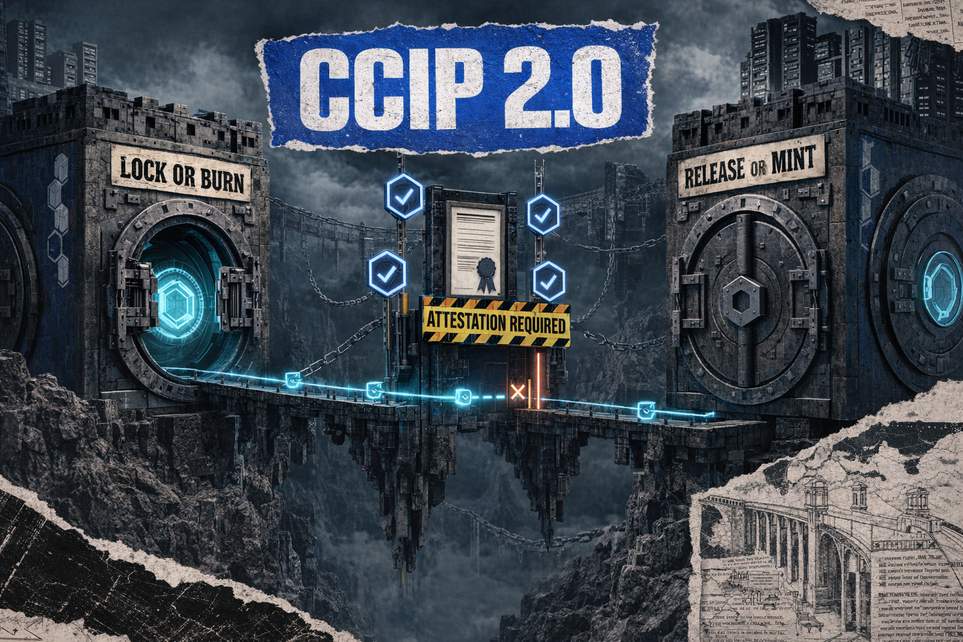
Chainlink CCIP 2.0 exposes bridge risk, and issuer gates trigger stalls
How CCIP 2.0 can turn a smooth transfer into a nail-biting pause
Chainlink’s CCIP 2.0 added a new toy to the toolbox: optional external verifiers (often called CCVs) that can be set as required checks before tokens show up on the destination chain. Sounds responsible, right? But here’s the twist: the source pool often locks or burns the tokens before those external verifiers have finished saying “yep.” That means you can have a perfectly successful send on the origin chain while the destination sits on hold waiting for an attestation that may be slow or absent.
Think of it like mailing a package and the sender marks it delivered, but the post office on the receiving end refuses to hand it over until someone else signs a special stamp. If that special someone is on vacation or their server ate the evidence, the package just rots in limbo.
The system’s default safety net is a Committee Verifier — a group of roughly 16 independent nodes — but CCIP 2.0 allows token issuers or third parties to run their own verifier and make its OK mandatory. When that happens, whoever runs that verifier gets a bit of power: their rules and uptime can directly affect whether your tokens clear the bridge.
What that means for holders, and how recovery works (or doesn’t)
If a required verifier goes quiet, the destination OffRamp won’t release or mint the tokens. The transfer can remain in a state where the source has burned or locked balances while the destination shows no execution — which Chainlink labels things like UNTOUCHED or FAILURE depending on what happened and where.
There are a few important realities to keep in mind:
– The lock or burn on the source side usually comes before the external attestation is available. That ordering is what creates the risk of a stalled completion.
– A missing attestation cannot be skipped by changing who submits the destination transaction or by throwing more gas at it. The OffRamp checks for required proofs no matter who calls it.
– Chainlink’s default executor automatically retries failed attempts within a configured window (currently an automated retry window around eight hours). But if the core issue is an absent verifier attestation, retries won’t magically produce that attestation.
– Manual execution paths exist, allowing anyone to submit the destination transaction once all required proofs are present. However, manual routes don’t help if the verifier never provides its attestation in the first place.
– There’s no general, built-in “cancel and refund” checkbox that returns source-chain tokens automatically if a required verifier never wakes up. Any issuer-specific refund or recovery process would depend on how that particular asset’s contracts and policies were set up.
There are also optional compliance hooks you should be aware of. A preflight hook on the source chain can reject a transfer before anything is locked (that reverts the origin transaction). Conversely, a postflight hook on the destination can reject release or mint after the source side has already started, which also leaves tokens undelivered until the policy condition is satisfied and the transfer is retried.
Lastly, CCIP 2.0 includes an option for faster-than-finality transfers. That can speed things up, but it’s a trade-off: choosing speed may expose the transfer to rare cases where deep reorganizations cause duplicate execution on the destination. Faster does not remove the need for required attestations from CCVs.
Bottom line: CCIP 2.0 gives issuers more control to define delivery conditions — which is handy for compliance and policy — but it also introduces extra points of failure. As a token holder you want to know three things: which checks apply to your asset, who runs each required verifier, and what remedies (if any) exist if a required attestation never arrives. If you don’t like surprises, treat those answers as a check-list before you hit send.
