
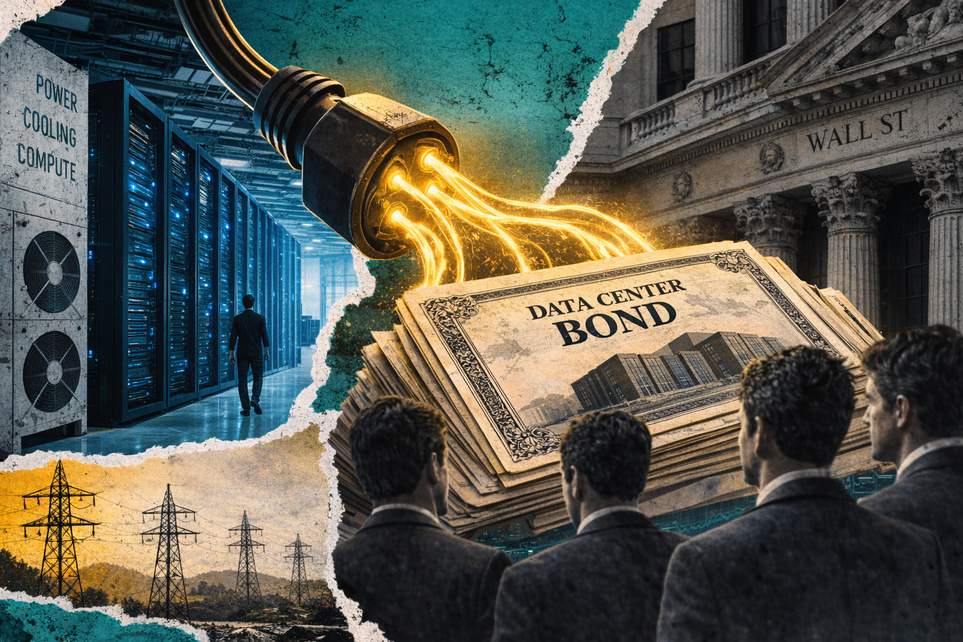
When AI’s Power Bill Becomes a Bond: How Megawatts Got Wall Street’s Attention
How a data center’s electric bill turns into something investors buy
Every time you ask an AI something, somewhere a rack of servers hums, fans whoosh, and the lights (and the cooling) keep the whole show running. Multiply that by millions of queries and you’ve suddenly got one of the largest line items on a building’s P&L: electricity.
Wall Street noticed this and decided the predictable cash stream tied to delivering power and compute is investable. Once a data center is built and has paying tenants, owners can move the property, its service contracts, and the recurring rent into a separate legal entity that issues debt. Investors get paid from the rent and operating fees after the bills—especially the electricity bill—are covered.
In plain speak: the bond isn’t just about square footage. It’s about a bunch of things that make compute actually happen—utility hookups, backup generators, cooling pumps, fiber, and long-term customer deals. Those megawatts of usable electricity are the key collateral; high power availability can make a bond attractive, and tight capacity or spiking power costs can make it risky.
What the market looks like and why it matters
Data-center securitizations have grown fast—from a few billion dollars a few years ago to many tens of billions by mid-2026. That scale-up reflects two forces: huge spending on AI-ready infrastructure and Wall Street’s appetite for steady, contract-backed cash flows. Deals typically put a good chunk of the sponsor’s equity up front and slice the pool into senior and junior tranches so different investors can choose their preferred risk/return.
There are a few quirks investors must underwrite. First, tenant credit: are the big cloud or AI customers reliable payers? Second, technical longevity: will the building keep offering the power density and cooling modern processors demand, or will it need pricey retrofits? Third, the timing mismatch: many deals plan for an expected repayment or refinance relatively early (around five years) while the legal maturity can be decades, creating refinancing risk if market conditions sour.
On the national scale, power needs are staggering. Recent energy studies suggest U.S. data centers could use somewhere in the neighborhood of several hundred terawatt-hours a year by 2030—estimates vary widely, but even conservative scenarios point to single-digit-to-teen percentages of total electricity demand. For bond investors, that wide range matters because changes in grid capacity, utility prices, or regulations can alter operating costs and therefore debt service available to note-holders.
Risks, clever fixes, and what to watch
These bonds are physical-asset credit plays dressed in finance jargon. If a grid connection is delayed, revenue starts late. If one or two big tenants dominate a campus and they leave or renegotiate, cash flow can kink. If chips keep getting denser, buildings may need expensive electrical and cooling upgrades. And, of course, electricity price spikes eat into the money that ultimately gets paid to bondholders.
On the flip side, operators that can flex computing loads, shift non-urgent processing, or deploy smart power-management strategies can protect margins and reliability—think of it as the data-center version of a demand-response trick. Also, the legal shape of these deals matters: recent regulatory letters have clarified that many data-center securitizations are treated more like real-estate financings than traditional asset-backed securities, which can change disclosure and structuring rules and lower issuance friction.
Bottom line: you’re buying exposure not to AI models, but to the plumbing that runs them. If that plumbing is well-built, well-contracted, and smart about power, the income stream can be steady. If it isn’t, the cute chatbot demo won’t help the bondholder when the lights flicker.
