
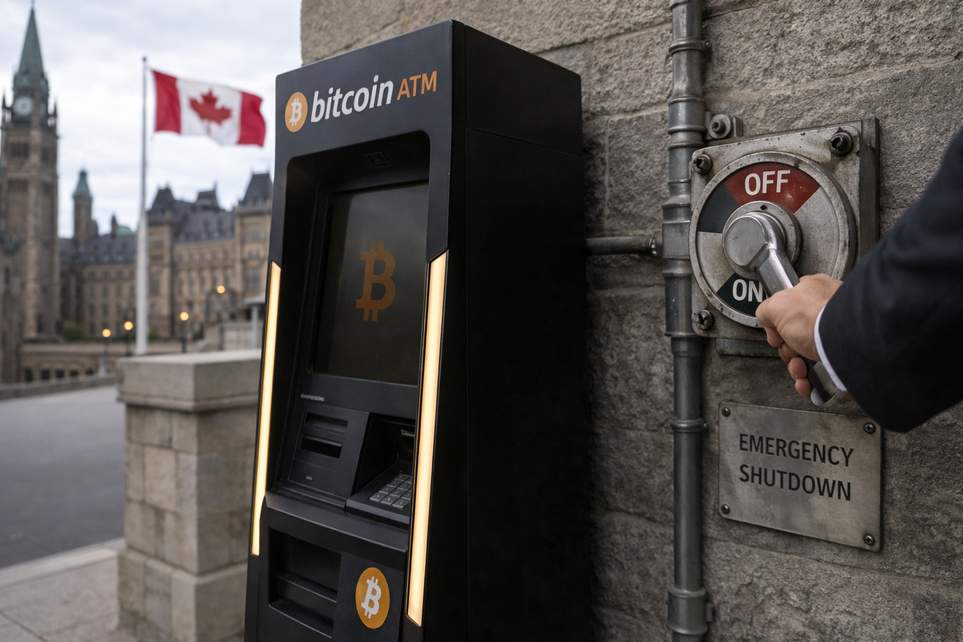
Canada’s Crackdown: Are Crypto ATMs About to Vanish?
Why Canada is going after the machines
Back in 2013, a Vancouver coffee shop installed the first bitcoin ATM and unleashed a retail craze. Thirteen years later, Canada has about 4,000 of these cash-to-crypto kiosks — more per person than anywhere else — and the federal Spring Economic Update 2026 has proposed banning them.
The trigger is fraud. Canadians reported losing more than $704 million to scams in 2025 and over $2.4 billion since 2022. Authorities warn those numbers are only a sliver of the real total. Unattended crypto ATMs are being called out as a preferred way for scammers to collect money and for criminals to move illicit cash.
Part of why regulators zeroed in on the machines is practical: they’re visible and easy to explain to the public. They sit in corner stores and malls, accept cash, and often require minimal ID for small purchases. There’s nobody behind the counter to spot red flags, and that combination — high visibility plus low verification — makes them an attractive political target.
Reports and internal analyses from financial authorities suggest these kiosks have been a persistent weak point. Former employees have also said fraud through ATMs was a known issue inside companies, which complicates the idea that simple compliance tweaks will fix the problem.
Who’s hit by a ban — and what happens next?
The government’s proposal isn’t a blanket ban on buying crypto; it’s focused on unattended, cash-to-crypto machines. People would still be able to purchase digital assets through regulated, staffed money-service businesses. That technical distinction matters on paper, but for many actual users the alternatives aren’t equivalent: underbanked people, cash-dependent shoppers, or someone who just wants a quick small buy at the corner store may suddenly lose access.
Other countries have taken different approaches: registration rules in the UK effectively sidelined operators, Australia imposed per-transaction limits, and some U.S. jurisdictions capped daily ATM transfers. Canada’s idea is more categorical — remove the machines rather than nudge behavior with limits or paperwork.
The government is also beefing up enforcement capacity to follow the money, which makes this part of a broader crackdown on illicit finance. The underlying point is political as much as technical: once a retail product becomes synonymous with scams, the easiest public answer is often to pull it from circulation.
There’s a wider implication too. Any retail-facing crypto product that looks easy to use, accepts cash or low-verification flows, and sits in plain sight — prepaid crypto cards, simple wallet apps, or other on-ramps — could fall into the same risk window if fraud sticks to its reputation. In short, visibility plus simplicity equals political vulnerability.
So the country that once introduced the first bitcoin ATM might soon make them illegal. That’s a dramatic switch and a clear signal: make something visible and low-friction, and if it becomes a headline-ready problem, it could be next on the chopping block.
