
Coinbase World Cup Alert Exposes Prediction Market Proof Problems
The weird alert: what actually happened
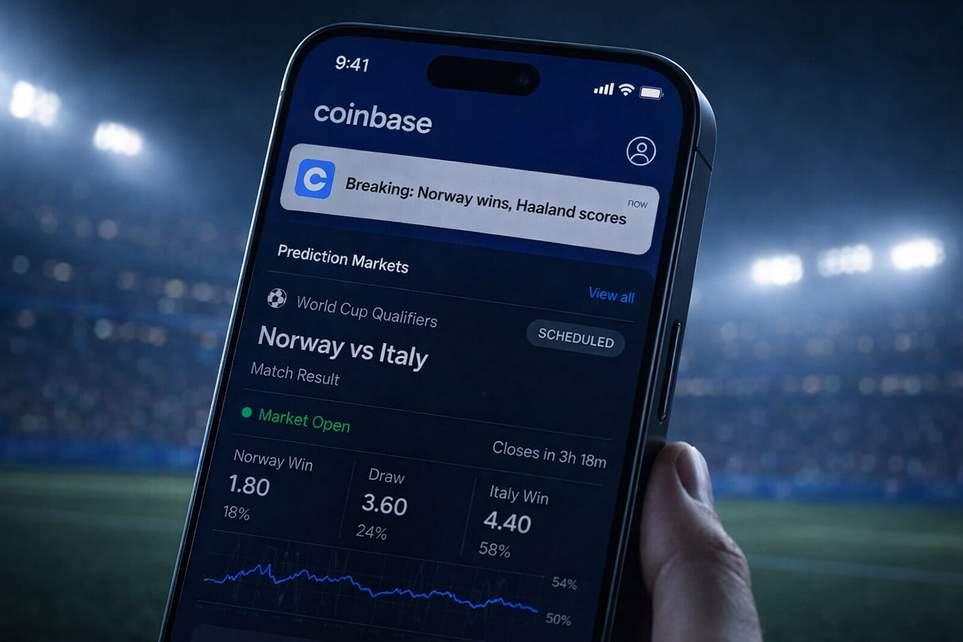
So here’s the headline: a Coinbase alert once flashed a “match finished” message before the match had actually finished. It claimed a World Cup game ended with a particular player scoring — very dramatic, very premature. People noticed, screenshots spread, and the exchange’s CEO said they were looking into it. Cue the internet’s delight in chaos.
Whether that notification came from an AI summary, a third-party feed, or someone hitting the wrong button in the app, the result was the same: consumer-facing trading software pushed what looked like a verified outcome while the real-world event was still unresolved. That’s more than an oops — it’s a design mismatch between breaking content and tradable markets.
Why this is a problem (short version: proof matters)
Prediction markets let people bet on real-world events. They’re supposed to capture what traders believe will happen. But if the same app that shows markets also pushes alerts that read like final results, users can easily confuse commentary with confirmation. That’s dangerous because those markets react to information — sometimes in seconds.
Imagine getting a push that says “It’s over!” and then seeing a market shift right after. Even if nobody can prove they traded because of the alert, the interface just taught you to treat the notification as authoritative. In other words: a wrong or premature message near a tradable market doesn’t stay a harmless sentence. It becomes market-adjacent noise that can change behavior.
Speed is great until speed outruns proof. If the content pipeline is faster than verification, an app nudges people toward conclusions before any reliable source has confirmed them. That’s the boundary this incident highlights — the difference between “we think” and “we know.”
How exchanges can stop the madness (practical fixes)
Fixing this doesn’t require magic, but it does need clear rules. Start by always labeling the state of an event: rumor/social report, scheduled, in-play, or officially resolved. Make that state visible in the app so users don’t have to guess whether a notification is gossip or a settled fact.
Track provenance for every alert: log the data source, the timestamp when something became eligible to be called final, and whether a human signed off. If a push notification is generated by an algorithm, say so — and also show whether external verification exists. A tiny badge of “verified” or “unverified” beats vague wording every time.
Another useful control is gating language. Don’t let systems use final-result phrasing until a verified threshold is crossed. That might slow some alerts, but it preserves trust. Speed without proof can turn notifications into an unpriced part of market structure — which is bad for everyone except chaos.
Finally, keep an audit trail for any push tied to a tradable market. Operators should be able to answer: who produced this alert, when, and what proof supported it? Those logs aren’t just bureaucratic fluff — they’re the difference between an honest mistake and a systemic risk to market integrity.
At the end of the day, prediction markets can be fun and useful, but only if the app keeps commentary, forecasts, and confirmed results clearly separated. Otherwise you get dramatic notifications and very confused traders — which, frankly, is entertaining to watch but terrible for trust.
