
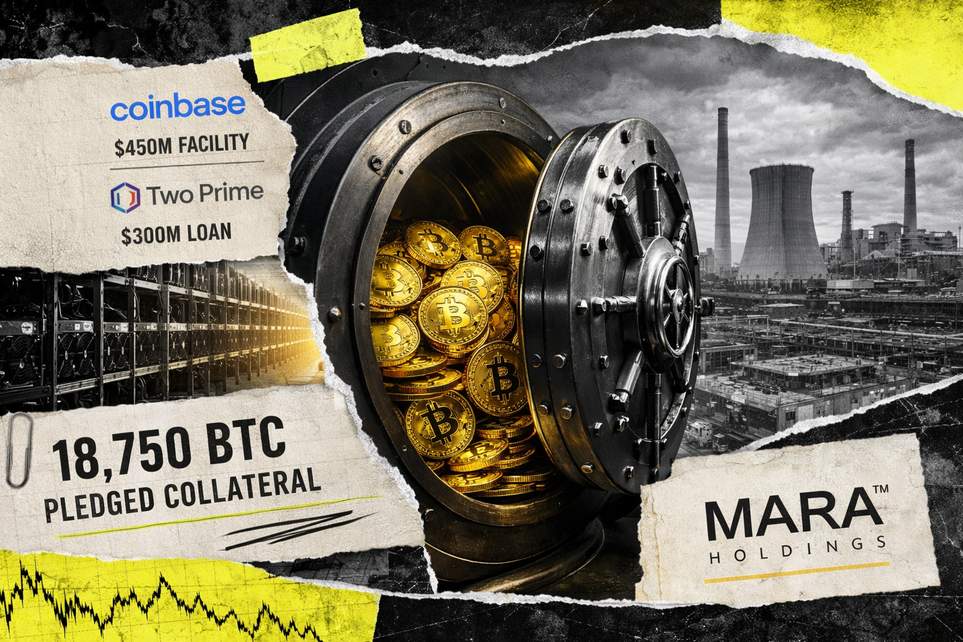
MARA cashed out most mined BTC, then put 18,750 coins up as collateral for an AI power play
Short version: MARA sold almost all the Bitcoin it mined in Q2, then borrowed big dollars against a huge chunk of its remaining stash to bankroll a planned energy-and-AI project. It’s bold, a little theatrical, and frustratingly vague in the parts you actually want to know.
The deal in plain English
Here’s what happened without the corporate-speak fog: in Q2 MARA mined 2,422 BTC and sold 2,213 of those coins (about 91% of what it mined that quarter). That brought cash in the door, but then the company turned around and entered into $750 million of fully drawn credit facilities on Aug. 4.
Those facilities break down like this: one $450 million facility from a large exchange group (a mix of $300 million new borrowing and a $150 million refinance) and a separate $300 million loan from a specialty lender. In total the company said it got $600 million of new dollar liquidity — money that can be used for general corporate purposes and to help pay for a planned acquisition called Long Ridge, a power site the company wants to develop for AI and high-performance computing tenants.
To secure the loans, MARA initially posted 18,750 BTC as collateral. For context, the company reported holding 35,577 BTC as of June 30; the pledged amount is roughly 52.7% of that snapshot. That sounds like a lot — and it is — but the dates don’t line up exactly, so you can’t treat the two numbers as a perfect apples-to-apples comparison.
Why it matters — the risks, the numbers, and the missing pieces
Numbers worth remembering: at quarter-end MARA classified 26,307 BTC as unrestricted, 4,742 BTC as loaned, and 4,528 BTC as pledged collateral. Those last two categories add up to 9,270 BTC, but the company didn’t say how much of that overlaps with the 18,750 BTC used as collateral for the new facilities. In short: there’s an unknown overlap, and if you try to add things up you’ll probably double-count.
The loans require MARA to keep enough Bitcoin posted as collateral. If collateral levels slip and aren’t fixed in time, the lenders can treat that as an event of default and may liquidate the pledged coins. Important caveat: the filing does not disclose the maintenance ratios, margin-call triggers, cure periods, or the exact formulas used to determine when a lender can sell collateral. That lack of transparency means you can’t work backward to a concrete Bitcoin price that would force MARA into a margin call or a fire sale.
Other useful financial tidbits: Q2 revenue was $174.9 million, while the company posted a net loss of $611.3 million for the quarter — a number that includes a $342.7 million mark-to-market (fair-value) hit on Bitcoin. For the first half of the year, MARA reported $471.3 million of net cash used in operating activities. Those mark-to-market losses aren’t the same as cash leaving the bank, but combined they paint a picture of meaningful accounting and cash pressure.
The Long Ridge acquisition is still conditional. Regulatory clearance is not fully in the bag: one agency lifted part of the waiting period, but approval from the regional energy regulator is still pending. The deal has an outside date at the end of November that could stretch to June 30, 2027 under certain conditions, and there’s a possible $75 million termination fee under some scenarios. Management says it’s aiming to secure at least one AI or high-performance-computing tenant at the site before year-end, but no leases have been announced yet.
Bottom line: the financing gives MARA substantial dollar liquidity to pursue the Long Ridge plan and other corporate needs, but it does so by tying up a very large chunk of Bitcoin as collateral under terms that haven’t been fully disclosed. That makes the company’s remaining unencumbered Bitcoin “headroom” impossible to verify from public filings alone. If you like bold moves with a side of ambiguity, this one’s for you — if you prefer neat, transparent balance sheets, proceed with caution.
