
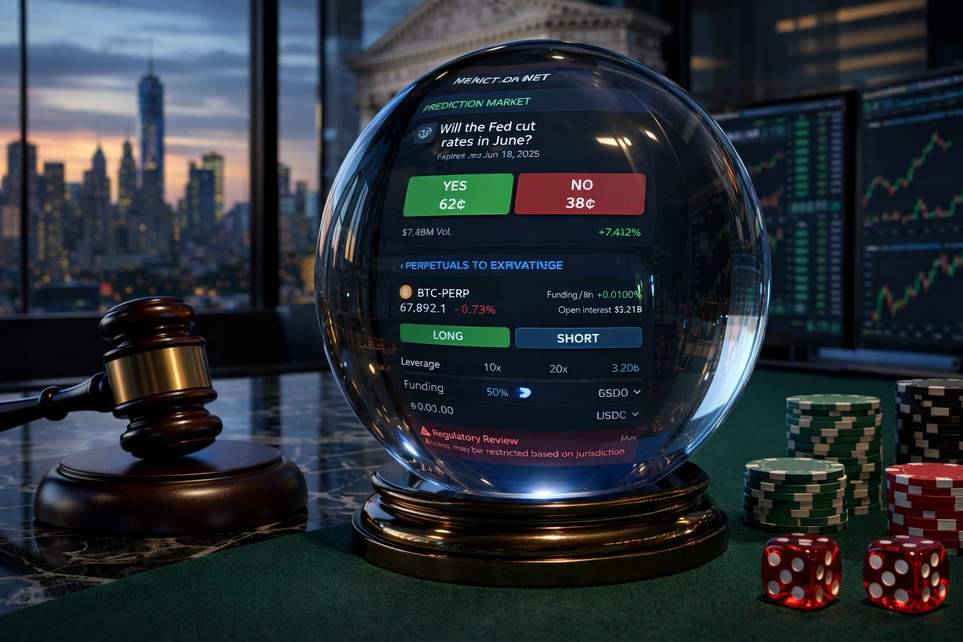
New York demands $3.4B in crypto fines: Inside the fight to turn prediction apps into nonstop leverage casinos
Prediction-market apps — the places people used to bet on who wins the election or whether it’ll rain on game day — are trying on a new, much riskier outfit: perpetual futures and high-octane leverage. It’s a product move that could turn casual, once-a-week bettors into full-time, margin-call-loving thrill seekers. It’s also landed the industry square in a legal dumpster fire: regulators are arguing whether these sites are legitimate financial venues or just casinos with extra features.
From one-off bets to 24/7 leveraged trading
Historically, prediction platforms sold simple yes/no contracts around discrete events. You buy a contract, the event resolves, the contract expires, everybody goes home. Now, many of those platforms are planning to offer perpetual futures — contracts without an expiration date that let traders hold positions forever if they keep meeting margin calls. Toss in leverage (sometimes advertised up to 50x) and you’ve gone from quiet forecast markets to something that looks and smells a lot like a derivatives exchange.
The business logic is obvious: spot crypto trading slowed, while perpetual futures churned enormous volume. The lure is constant fee income and the hope of turning episodic users into daily traders who create steady liquidity. Prediction platforms argue this is how they’ll survive between headline-driven spikes. Critics say it’s a risky pivot that replaces harmless forecasting with perpetual speculative gambling.
Competition is heating up on all sides: offshore perpetual exchanges can easily add event contracts, while traditional brokers and centralized venues are flirting with prediction-style products. The result is a messy mash-up where technical hurdles, customer acquisition, and liquidity all collide — and whichever platforms can actually bootstrap consistent liquidity will win the battle for users.
Regulators, lawsuits, and the gambling label
The move toward perpetuals hasn’t gone unnoticed by regulators. State officials — with New York’s attorney general at the front — have launched major enforcement actions, claiming platforms are offering unlicensed gambling and skirting consumer protections. One recent lawsuit demands roughly $3.4 billion in penalties and restitution, accusing major firms of evading state rules and exposing vulnerable users, including minors, to addictive betting mechanics.
On the flip side, federal regulators tasked with derivatives oversight argue these products fall under federal authority. That has produced a tug-of-war in courts: federal agencies suing to block state crackdowns, and judges weighing whether these event-based contracts are betting or bona fide market instruments. Some appeals courts have sided with federal jurisdiction in narrow cases, but the legal picture remains fragmented and unpredictable.
That legal murk matters for product strategy. Some operators see perpetuals as a defensive move to operate under clearer exchange-like rules; others view the change as a short-term gambit that dodges one regulatory headache only to invite another. If prediction markets truly start behaving like derivatives venues without matching the risk controls, regulators may very well treat them as exchanges — with all the compliance costs that entails.
Bottom line: the industry is racing to blend forecasting and derivatives because the upside is huge, but the downside could be ruinous. Expect bigger lawsuits, more courtroom fights over who gets to regulate what, and a lot of companies betting they can grow into compliance before the music stops. Spoiler: the music is still playing — loudly, and with lots of margin calls.
