
Paul Sztorc’s eCash fork: a new Bitcoin split, Satoshi drama, and why you can probably chill
Headline version: longtime Bitcoin dev Paul Sztorc has pitched a hard fork called eCash aimed at roughly August 2026 (around Bitcoin block 964,000). The pitch: copy Bitcoin’s history, give every BTC holder 1 eCash per BTC at the split, and boot up a Bitcoin-like layer 1 with familiar mining and some Drivechain-style sidechain plans. The spicy part: an allocation decision that would put a large chunk of copied coins linked to early Satoshi-pattern addresses into a separate pool — Sztorc later clarified that number would be about 600,000 eCash instead of the larger figures that were being floated.
What is this fork even proposing?
Imagine cloning Bitcoin’s ledger at a certain block height and saying, “Here — same balances, new world.” That’s the basic idea. If your wallet shows 4.19 BTC when the snapshot happens, the eCash ledger would theoretically show 4.19 eCash. Bitcoin itself stays put: the original BTC remains governed by the existing Bitcoin software, consensus rules, and whatever private keys control those coins.
The eCash plan leans hard on familiarity. The proposed chain would use the SHA-256d mining algorithm, do a one-time difficulty reset at launch, and otherwise behave a lot like Bitcoin Core. It also aims to activate BIP300/BIP301-style mechanisms so sidechains can plug in without rewriting Bitcoin mainnet — think Drivechain concepts being part of the new chain, not a change to Bitcoin itself.
Where things get messy is the treatment of certain dormant balances. Rather than copying every coin exactly as-is, the proposed rules would reassign a subset tied to presumed early-miner patterns and allocate about 600,000 eCash to that pool. That’s the political and ethical kerfuffle: should a fork reassign copied balances before launch, or should it be a strict 1:1 mirror?
Why this matters (and what you should actually do)
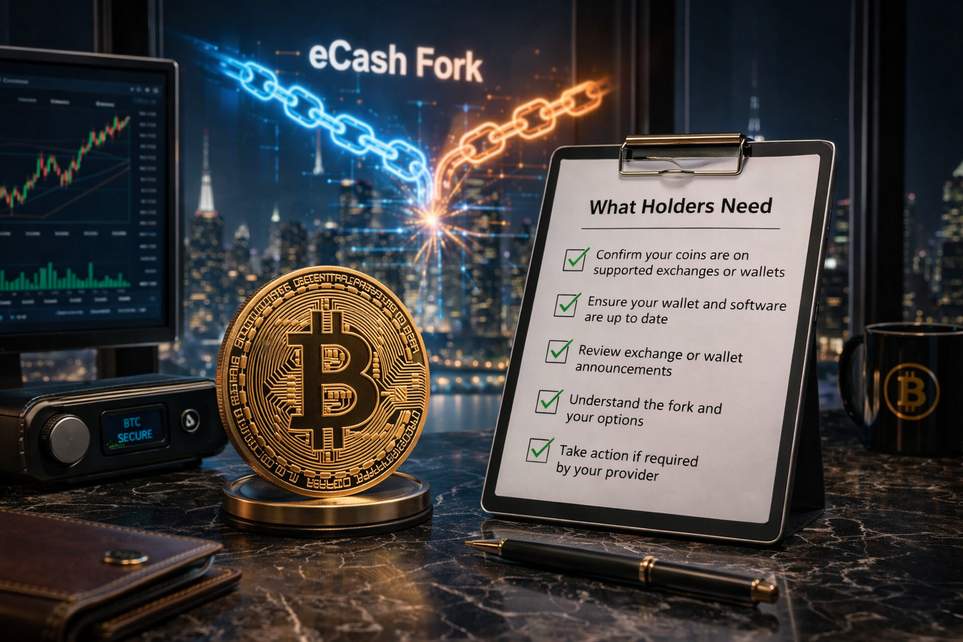
For most regular holders the immediate takeaway is simple: your BTC stays BTC as long as you don’t import keys into sketchy new software or click on random claim pages. You don’t have to do anything to “preserve” your Bitcoin other than keep your seed phrase safe and avoid rushing onto some shiny new splitter tool built by strangers on the internet.
Operationally, a fork only becomes meaningful if several things happen: working launch software, clear replay-protection behavior, splitting tools that don’t eat your keys, miners willing to secure the new chain, exchanges/wallets/custodians deciding to support it, and some actual market liquidity. Until those pieces materialize, any eCash balance is mostly theoretical — a copied ledger entry with no real plumbing behind it.
Replay protection is a big technical safety valve. Without it, a transaction you make on one chain could be mirrored on the other, which gets people’s coins eaten alive. The current discussion says default eCash software should try to block eCash spends from replaying on Bitcoin, but behavior can depend on the specific wallet or tool you use. That makes conservative behavior (don’t import keys into unknown apps!) the sensible move.
Custodial users have a different headache: exchanges and custodians typically evaluate forked tokens case-by-case. Some platforms may ignore the forked coin, others might allow withdrawals only, and a few might list it if the chain proves secure and liquid. That decision takes time and internal engineering and compliance checks, so expect a wait-and-see posture from big providers.
Taxes also complicate the picture. In some jurisdictions, a fork plus an airdrop can create taxable income at the moment you gain control of the new tokens. Whether that applies depends on whether you actually receive and can dispose of the new coins — and that’s easier to determine after exchanges and wallets state their policies. If you’re seriously concerned, ask a tax pro rather than guessing on a forum.
There’s also a naming mess to navigate. There’s already a differently branded “eCash” project in the wild and other ecash-related tools with similar names. That overlap increases the chance of typos, fake support pages, and mistaken transfers. Bottom line: verify domains, tickers, and official wallet instructions before interacting with anything that claims to be the new fork.
Final, boring but crucial advice: don’t rush. Holders should avoid random claim sites, unvetted wallets, and social media links promising instant access. Wait for clear guidance from reputable wallets, exchanges, and custodians, and for publicly auditable code and splitter tools. If you follow that path, your BTC remains your BTC and you won’t have to learn the hard way what replay attacks and phishing look like.
