
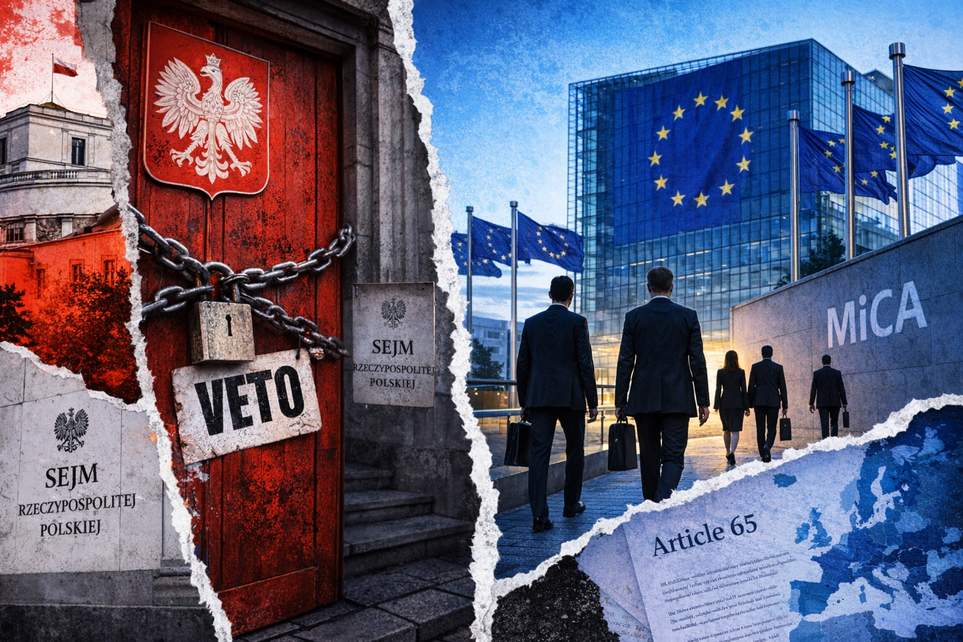
Poland’s crypto licensing deadlock hands EU rivals a head start
Poland’s crypto regulatory drama has left local businesses in limbo while their EU neighbors quietly head for the finish line. A key law that would name the domestic authority responsible for handling new crypto licenses never made it back into force after parliament couldn’t overturn the president’s veto. Translation: Polish firms can’t get home-grown authorizations yet — but some EU rivals can still sell into Poland.
Why Polish firms are stuck
At the heart of the mess is a simple bureaucratic missing piece: there’s no officially designated Polish regulator authorized by law to accept ordinary MiCA license applications. Without that legal designation, the Polish financial regulator can’t start processing domestic authorizations. The attempt to reinstate the law failed in parliament, so the status quo remains — and it’s pretty unhelpful if you’re a homegrown crypto company waiting for a green light.
To make matters worse, the transition protections that used to let some businesses keep operating under an older national register expired on July 1. Authorities have said that simply being on that old list no longer counts as authorization, so the old safety net is gone and the new one isn’t up yet. Cue lots of frustrated compliance teams and awkward phone calls to legal counsel.
The cross-border loophole (and who’s laughing)
Here’s the kicker: the EU’s MiCA framework includes a passporting mechanism. If a crypto firm is authorized in one EU member state, it can notify its home regulator and then operate across the bloc — including Poland — once the paper work or waiting period finishes. That route is still open. So a firm that got its MiCA approval in, say, Amsterdam or Tallinn can keep serving Polish customers while a purely Polish applicant sits on the bench.
This creates a strong incentive for Polish groups not to wait around. Some will seek authorization in another EU country or route services through an affiliated entity that already has MiCA clearance. The end result: foreign-authorized providers get easier market access during the pause, and Polish-only registrants get squeezed.
Bottom line: until lawmakers formally name the competent national authority, domestic crypto companies will either have to be very patient, find a foreign partner, or set up camp in a different EU capital. Meanwhile, cross-border competition marches on — and the scoreboard currently favors whoever already has a MiCA stamp in their passport.
