
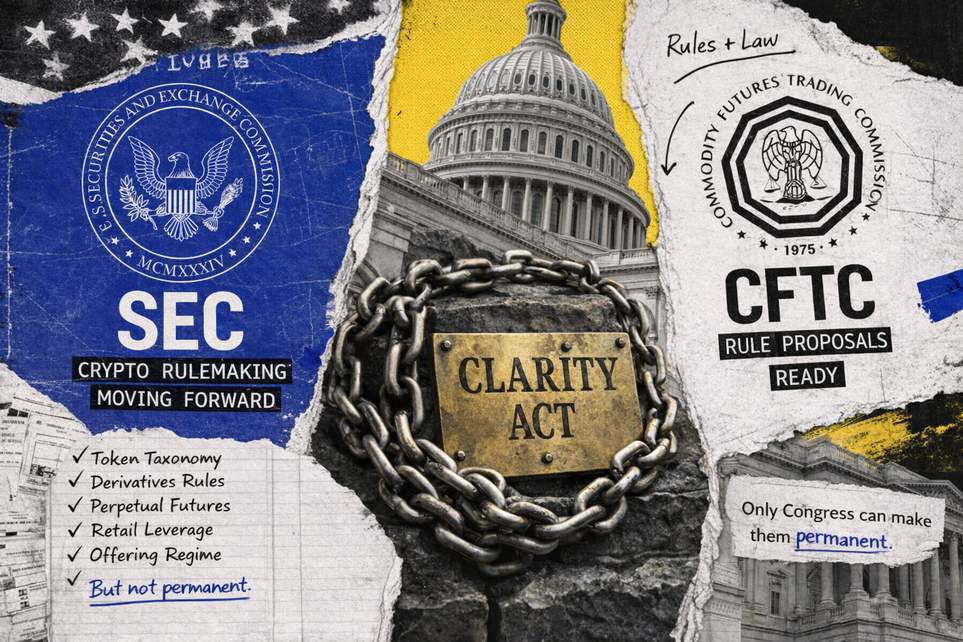
SEC and CFTC Racing to Write Crypto Rules — But Only Congress Can Make Them Stick
Agencies are sprinting — rulebooks in progress, permanence not guaranteed
Short version: the SEC and the CFTC are busy scribbling new crypto rules like students cramming before finals, and they want to finish before the semester ends. Both agencies have signaled they’ll push out proposals and interpretations on crypto activity — from token classifications and staking to derivatives and retail leverage — even if Congress doesn’t pass a comprehensive law first.
That said, there’s a big asterisk. Agencies can issue rules, memos, and guidance, but they can’t write permanent statutes. Rules born from the agencies’ authority can be meaningful and stick around for a while, but only Congress can pass a law that can’t be casually rewritten by the next administration. Think of agencies as kitchen staff inventing a new dish; Congress is the cookbook publisher who can make it canonical.
Practically, this has already played out: regulators teamed up on an interpretation that distinguishes many tokens from securities and even spelled out how things like staking, mining, wrapping and airdrops fit in. The CFTC has used its tools to greenlight a Bitcoin perpetual futures contract and is working on retail-leverage limits and a new exchange registration category. Meanwhile, the SEC has flagged its own proposals, including a possible tailored offering regime for certain crypto investment contracts.
But not all agency moves are equal. Staff memos and interpretive releases can be useful short-term signposts, yet they’re more fragile than a full rule made after notice-and-comment. Recent court rulings have also made it harder for agencies to claim wide-ranging power just by pointing to ambiguous statutes, which means judges may be less forgiving when an agency stretches its reach.
The upshot: a completed, properly issued rule (the kind that goes through notice-and-comment) takes a lot more effort to undo. If an agency finalizes a rule, the next administration can’t simply reverse it overnight — they normally have to run through the same formal process and explain themselves to a court, which reviews such reversals under an arbitrary-and-capricious standard.
Why this matters for Bitcoin, altcoins, and the CLARITY showdown
Where this really hits the market depends on the asset. Bitcoin is already sitting in the most comfortable legal outfit of the lot: treated and traded like a commodity with a deep derivatives market. That makes Bitcoin less sensitive to a delayed statute than many tokens and platforms that rely on clearer regulatory labels to scale institutional custody, bank-facing rails, and regulated leverage.
The congressional side of the story is still very much alive. The House has already passed a version of a digital-asset bill, but the Senate hasn’t moved final legislation yet. There’s a procedural cliff around mid-September when senators could vote to advance the bill — that step needs 60 votes — and if that hurdle is cleared, negotiators would then try to iron out thorny issues like jurisdiction, stablecoins and other sticking points.
Two simple scenarios are worth picturing. In the bullish version, the Senate musters the votes, lawmakers resolve the big fights, and Congress enshrines clearer lines between SEC and CFTC authority. That would give industry players real, durable predictability and let institutional activity and exchange infrastructure grow with greater confidence. In the bearish version, the procedural vote fails or a deal collapses later, leaving regulators to continue governing through interpretations, exemptions and piecemeal rules, and making the next election cycle the real turning point.
For the rest of the crypto ecosystem — altcoins, staking services, DeFi platforms — the legal picture is still hazy. Those projects face a risk premium that only statute can entirely remove. Regulators can do a lot within the powers they already have, but permanence? That’s Congress’s job.
So expect busy agency work, lots of draft rules and interpretive guidance, and headlines galore. But remember: a rule that survives the next administration and the courts usually starts with a law, not a press release.
