
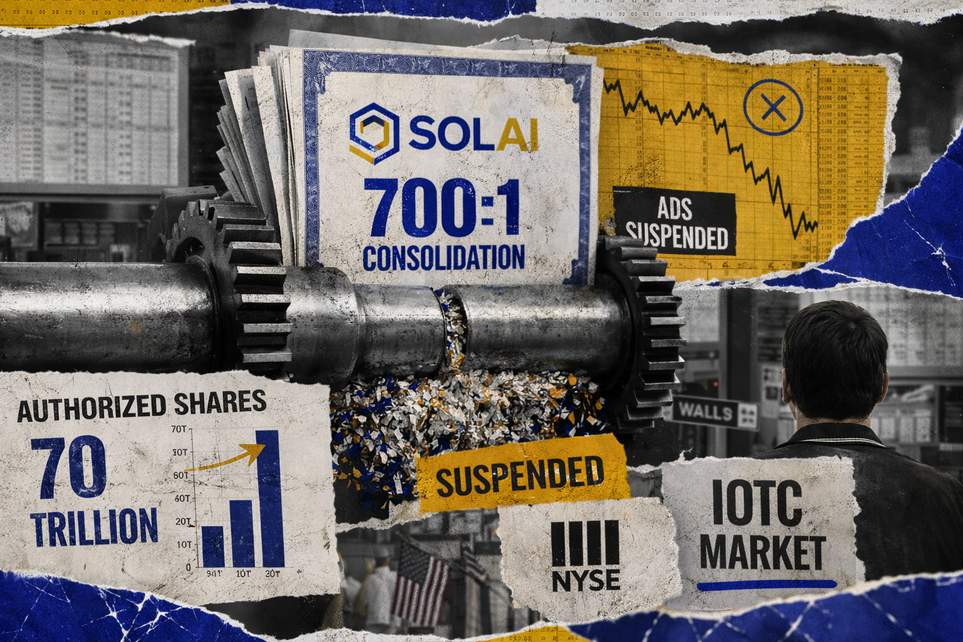
Solana treasury firm’s big share shuffle: 700-for-1 consolidation leaves room for 100 billion shares
What happened
SOLAI Limited (the company formerly known as BIT Mining) pulled a classic corporate magic trick: shareholders approved a two-step share reset that effectively consolidated ordinary shares 700-for-1 and left the company with 100 billion authorized Class A ordinary shares on a post-consolidation basis. The approval came after the company increased its pre-consolidation authorized share count to a very large number, then immediately combined every 700 old shares into one new share.
To give you the number salad: before the consolidation the firm had reported roughly 3.09 billion Class A ordinary shares issued and outstanding (1.92 billion at the end of March plus about 1.16 billion issued in early June). Do the 700-for-1 math and that converts to about 4.41 million post-consolidation shares outstanding. The authorized ceiling, meanwhile, sits at 100 billion post-consolidation — which, on the face of it, leaves a massive unissued pool (roughly 99.996 billion shares) if you eyeball the numbers the company disclosed.
This corporate reshuffle follows a separate action a few weeks earlier that changed the company’s American Depositary Share (ADS) ratio from 100 ordinary shares per ADS to 700 per ADS via an ADS reverse split — another move that fiddles with how ownership is counted on the ADR/ADS side without necessarily issuing or cancelling the underlying ordinary shares.
One more practical note: trading of the company’s ADSs on the New York Stock Exchange was suspended earlier after average global market capitalization fell under the exchange’s threshold. The firm’s ADSs have since appeared on over-the-counter listings, though that’s a different animal from a main exchange ticket.
Why it matters (and what to watch)
Okay, so lots of zeros. But why should anyone care? Two big reasons: clarity and capacity.
First, shareholders and holders of the company’s ADR/ADS instruments need clarity about the new issued-share count and how the different ADS ratio changes actually interact with the ordinary-share consolidation. Those details matter if you’re trying to figure out dilution, voting power, or ADS entitlements — and right now the story needs a clearer accounting of the post-consolidation numbers.
Second, leaving a gargantuan authorized-but-unissued share pool gives the company flexibility — for fundraising, acquisitions, compensation plans, or other corporate maneuvers — but it also raises dilution risk if management decides to use that capacity. The company hasn’t announced a specific plan for the huge remaining authorization, so it’s a watch-and-wait situation for investors.
What to look for next: an updated issued-share register, explicit statements about planned uses for the authorized shares, and any new depositary instructions explaining exactly how ADS holders are affected. Until those pieces fall into place, the numbers will keep looking weird and everyone will be guessing how the company intends to use the newfound headroom.
