
They Spent $100M to Defend STRC — DeFi Repackages the Risk into a ‘Safer’ 7% Play
Quick version: a company has been on a mission to keep its STRC preferred stock close to $100. Another team built a DeFi-like split (two tranches) that tries to turn STRC’s roller-coaster into something calmer for certain investors — the senior slice aims for roughly 7% APY while the junior slice eats the first losses (for higher yield potential). If you enjoy spreadsheets and mild financial melodrama, buckle up.
What Solstice built, and why Strategy has been babysitting STRC
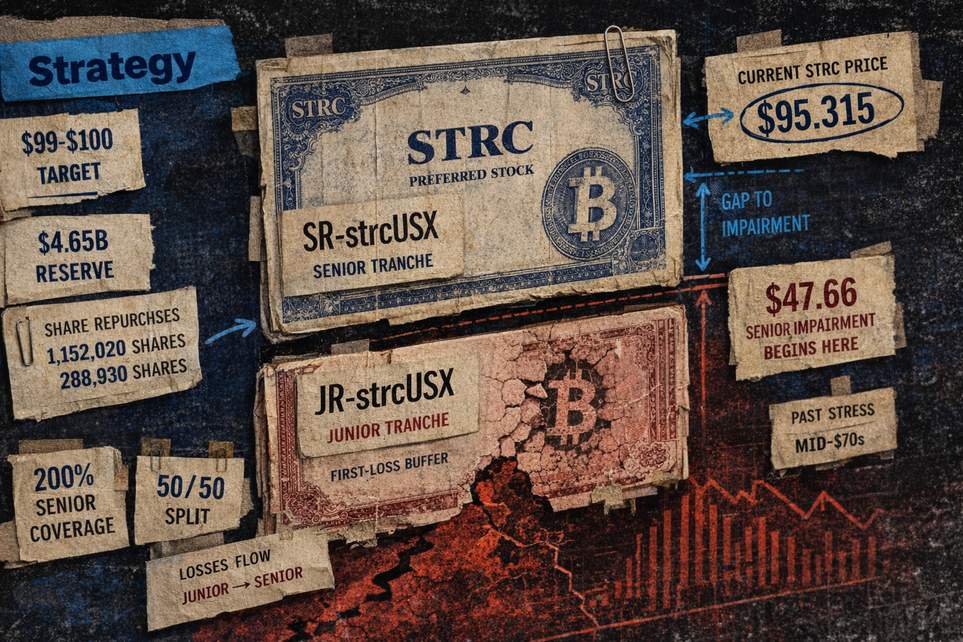
Solstice announced a tranched product based on Strategy’s STRC preferred shares. Under their model, senior holders don’t start taking losses until STRC drops below about $47.66 — roughly half of where STRC was trading recently (around $95.3) and well under the $100 par value.
That $47.66 figure is not engraved in stone; it’s a modeled “senior-impairment” threshold based on Solstice’s current assumptions and the coverage rules they built. The team says those assumptions can be tweaked, which is financial-speak for “this could change if the math or markets change.”
The underlying company, Strategy, has been actively managing STRC’s market price for weeks. It rolled out a policy package in late June that mixes a dollar reserve, a tweak to dividends, and buyback authorizations — explicitly aiming to keep STRC in the high-$90s. In late July it repurchased about 288,930 STRC shares for roughly $25 million at an average of about $86.52 per share. Then in early August it sold about $108.6 million of Bitcoin and used the proceeds to buy back another 1,152,020 STRC shares. The company also reported a multi-billion-dollar reserve (reported as $4.65 billion at the time), and Solstice baked that policy into its risk model — noting that any departure from it is a named risk.
How the tranche works, the math, and the awkward human part called ‘redemptions’
The structure splits exposure into two tokens: the senior slice and the junior slice (think SR and JR). For every $100 of exposure the product models $50 of senior and $50 of junior — that 50/50 split creates a 200% senior coverage ratio on paper. Junior holders take losses first, and in return they shoot for a much bigger yield than the senior side’s target (senior is roughly 7% APY).
STRC itself carries a high stated dividend (around 12% annually), which, before fees and the tranche split, would translate to an aggressive Bitcoin-fueled yield given STRC’s trading level. Solstice’s tranching divides that expected return between junior and senior, and the senior portion is basically pitched as a NAV-like return instead of a bet on STRC’s day-to-day price moves.
Crucially, losses only become real when the structure is forced to sell the underlying holdings — in other words, when a bunch of people redeem at once. Solstice modeled a past STRC sell-off (when STRC dipped into the mid-$70s) and found that senior would have stayed unscathed during that drawdown in every modeled scenario where senior holders didn’t all flee simultaneously. If all senior holders had redeemed during that same slide, junior would have taken roughly a 50% hit in their model. So the outcome is highly redemption-dependent — psychology and panic matter as much as valuations.
To avoid the senior bucket getting chewed up, Solstice built in stages: below the specified threshold the protocol flips into a restricted mode that freezes junior redemptions and stops new senior minting. The idea is to keep the coverage ratio from eroding further. If things get worse, the system moves into a liquidation phase where the protocol tries to sell collateral in an orderly way before senior takes a loss. Solstice also says market makers have agreed to buy STRC outside normal exchange hours to help tighten the gap between a continuously trading DeFi product and an underlying security that only trades during certain times.
One important note: the tranche rearranges who feels the pain first, but it doesn’t eliminate the original risks tied to STRC. Strategy’s dividends still require board approval every period, and preferred securities don’t have a claim on specific Bitcoin reserves — they have a preferred claim on whatever assets remain. In plain English: if the parent company can’t or won’t fund dividends, that changes things regardless of how silky your tranche math looks.
So what are the likely outcomes? If Strategy’s buybacks and reserves keep chugging and market sentiment improves, STRC could march back toward the high-$90s, junior mark-to-market risk would shrink, and senior could start feeling more like a bond-ish yield product. If the market doubts that the company can fund preferred defenses forever and STRC slides back toward the mid-$70s, junior outcomes hinge on whether holders panic in unison — the exact scenario Solstice flagged as the real swing factor.
Bottom line: Solstice built a system to decide who gets hurt first when STRC drops. The $47.66 line looks comforting on paper, but it only holds if the tranching mechanics, redemption freezes, liquidation playbook, and outside-market behavior all work the way the model assumes under real stress. Translation: math + human behavior = drama.
That’s the headline — a DeFi-ish product trying to turn an unruly preferred stock into a smoother, NAV-style return for some investors, while leaving the original risk firmly in place for others. If you like both financial engineering and tense social dynamics, you’ll want to keep an eye on redemption behavior and any changes to the company’s reserve-and-buyback playbook.
