
How Texas’ Bitcoin Mines Became the Grid’s Emergency Brakes — and Why AI Is Trying to Steal the Keys
Texas broke records, and ERCOT barely blinked
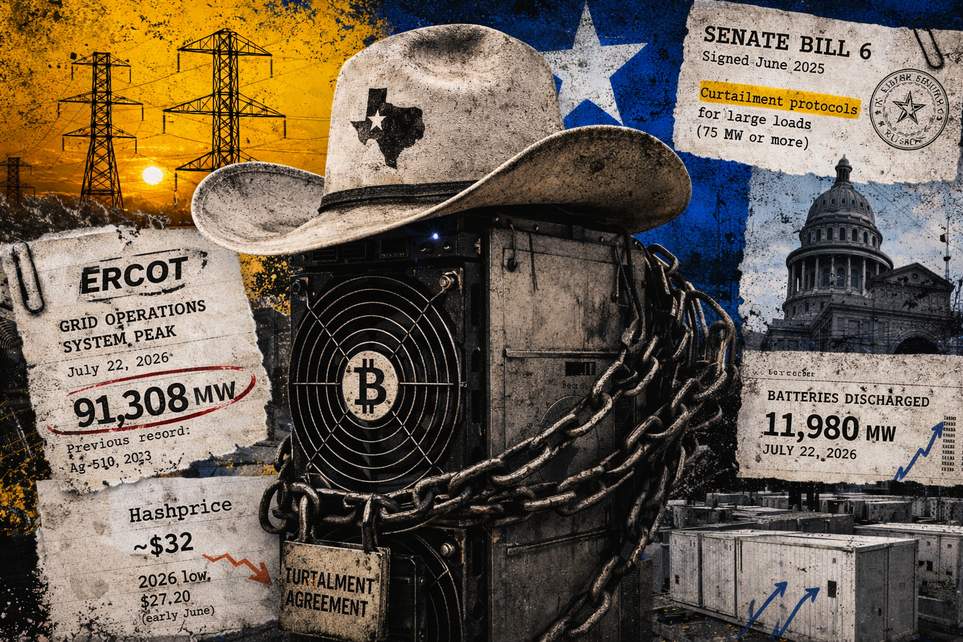
Late July felt like a sauna for the Lone Star grid. ERCOT logged a real-time peak around 91,308 megawatts on July 22 — a jump on the previous day’s 87,403 megawatts and well above the old 85,508 benchmark from 2023. Despite those numbers, no statewide plea to turn down the air conditioning was issued, and operators still showed more than 20 gigawatts of spare capacity during the worst of the afternoon rush.
That spare capacity is a quirk of how Texas runs its power system. ERCOT operates most of the state as an electrical island, managing dispatch, settlements, and the wholesale market for roughly 27 million customers. It tracks loads hour-by-hour (so headlines about peaks often refer to hourly averages, not one-second blips) and is the referee for everything from big generators to massive new computing customers waiting to plug in.
Bitcoin miners: the surprisingly useful speed-dial for emergencies
Enter the bitcoin mining warehouse: racks of purpose-built chips that crunch away 24/7. Unlike a steel mill or a factory with molten metal that you can’t just pause, these ASICs can be shut off and turned back on in minutes. That makes entire warehouses unusually flexible when the grid asks for relief.
ERCOT and some miners have informal and formal arrangements where the miners agree to curtail consumption during tight hours. When mining income (often summarized as “hashprice”) is low, pausing machines is cheap for operators; when crypto prices bounce back, that same pause becomes much more expensive in foregone coin. That simple economics explains why a miner might act like a giant, controllable load one summer and an immovable customer the next.
We’ve seen this in the wild. During the 2023 Texas heat wave one major operator reported curtailing most of its power use during peak hours and collected tens of millions in curtailment and demand-response credits — money that, in a weak coin price environment, can be far more valuable than the crypto they didn’t mine that afternoon. Over subsequent years credits have fallen and risen with markets and contract terms, which shows how much the arrangement depends on both grid need and mining economics.
There are several ways miners get paid for being flexible: avoiding buying expensive wholesale power, participating in demand-response and ancillary services programs, reselling or crediting power under fixed contracts, and lowering future transmission charges by reducing load during coincident-peak windows. Academic work using Texas data finds miners do trim usage as prices climb, but that responsiveness eases when mining payouts are healthier — so counting on miners as a permanent, reliable resource can be optimistic.
AI, data centers, batteries, and the fragile nature of the brake
The catch is this: the very flexibility ERCOT has leaned on is eroding. Many large halls that once hosted mining rigs are being retrofitted or leased as high-performance compute and AI centers. Those tenants demand uptime and signed service levels, which often ban the kind of curtailment that miners tolerated. In short, the emergency brake is being converted into a luxury sedan that refuses to stop.
At the same time, other technologies are stepping up. Batteries discharged record amounts during the recent peak and solar still contributes a huge chunk of the evening ramp, and both are dispatchable in ways miners aren’t: batteries inject stored energy on command, while a shutdown mine only stops subtracting load.
There’s also a system-risk angle. ERCOT tracked dozens of instances where large computing loads abruptly fell during grid disturbances, sometimes taking hundreds of megawatts off-line and triggering other equipment to trip. A single failed transformer once knocked out hundreds of facilities at once, creating a sudden swing that operators hate. That’s why ride-through performance and interconnection screening have climbed the priority list.
Policy is trying to catch up. New rules now force large new connections to include curtailment protocols, and the grid operator has been directed to buy reductions from very large customers. Regulators are also re-evaluating how transmission charges are allocated — a change that could shift the math for any operator deciding whether it’s worth shutting down for a pricey summer afternoon.
Bottom line: bitcoin mines helped give ERCOT a cheap, fast lever to pull when the lights were threatened. But higher crypto prices, machines being repurposed for AI, and a growing queue of massive new loads mean that lever is getting rusty. If coin values climb or more sites sign uptime contracts, the grid will need to buy or build other forms of flexibility — batteries, more dispatchable generation, or firmer contractual commitments — before that emergency brake disappears for good.
And yes, the grid is watching the thermometer and the trading screen at the same time. Whoever holds the megawatts in the future will also hold the keys to Texas’ cool summer nights — which sounds dramatic, but frankly, welcome to modern power politics.
