
Treasury just put a deadline on offshore stablecoins’ access to US customers
The rule, in plain (slightly sarcastic) English
Think of this as the Treasury drawing a legal chalk line around which stablecoins can be sold to Americans by regulated businesses. The tokens themselves aren’t being nuked — they can still zip between wallets and across blockchains — but regulated venues in the United States (exchanges, custodians, hosted wallets, and the like) will face new rules about which offshore stablecoins they can offer their customers.
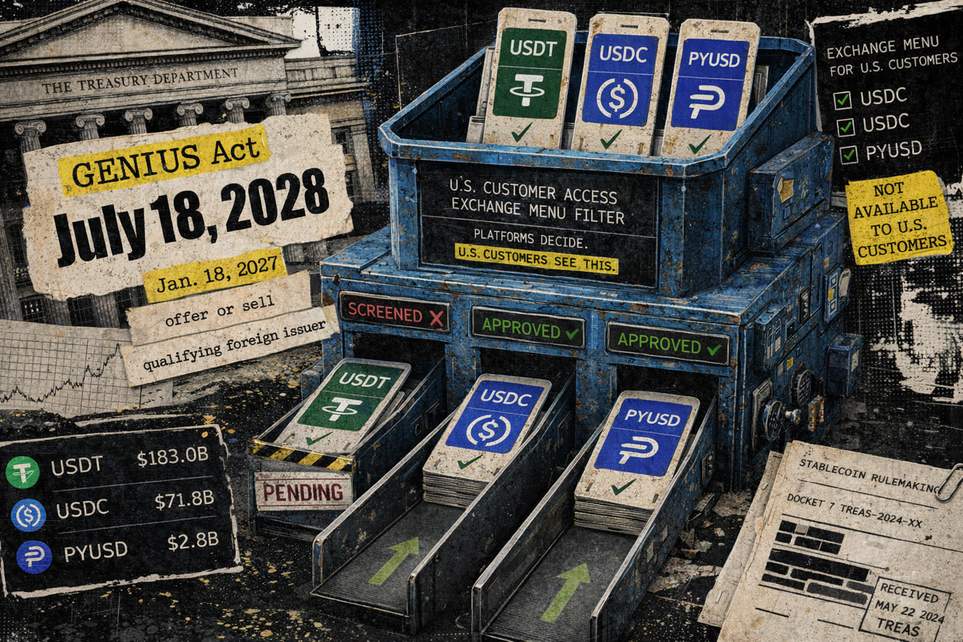
There are two big dates to remember. Starting Jan. 18, 2027, companies won’t be able to issue a payment stablecoin inside the U.S. unless they sign up to the new GENIUS framework. Then, on July 18, 2028, the choke point tightens: U.S.-facing service providers will only be allowed to list or sell stablecoins whose issuers meet specific, permitted criteria. Translation: your favorite offshore dollar token might keep existing on-chain but could vanish from the buy menu on U.S. platforms.
How it works and why it matters (for exchanges, issuers, and you)
“Digital asset service provider” sounds nerdy and boring, but it actually covers most of the businesses you use to buy, sell, hold, or move crypto. If a company makes money serving U.S. customers, it’ll likely have to check whether every stablecoin it offers has a clean legal path under the new rules. That includes exchanges, custodians, and any platform that helps users trade or custody tokens.
The proposal gives “offer or sell” a wide definition: it’s not just about clicking a buy button. Advertising a token, saying you’ll sell it if someone asks, or helping a user bypass geolocation controls can all count as offering. In other words, platforms can’t shrug and say “the user asked for it” as an easy defense.
Good news for privacy purists: self-custody and direct peer-to-peer transfers are mostly left alone. If you hold an offshore stablecoin in your own wallet and move it around without using a regulated service, the Treasury’s new rules generally won’t apply. The snag shows up when you try to use a covered platform to buy, swap, deposit, or otherwise interact with that token.
The Treasury also flagged a path for foreign issuers who want U.S. distribution: their home jurisdiction must have a stablecoin regime that’s considered comparable, and the issuer must register and demonstrate they can comply with lawful U.S. orders. That’s where the technical nitty-gritty — like whether a smart contract can freeze, seize, or burn tokens when required — comes into play. Issuers may need to show reserve reports, redemption policies, and technical controls to prove they’ll follow U.S. legal requests.
Practically speaking, this will nudge platforms toward tokens that are easier to vet and manage. Exchanges will weigh the commercial value of enormous liquidity (hi, big offshore tokens) against the legal and ongoing monitoring work needed to keep those tokens available to U.S. customers. Expect some concentration: simpler-to-approve coins get a head start, niche foreign tokens may face extra hoops, and some trading pairs could end up split by geography.
What does this look like for a regular user? By mid-2028 you might find that an offshore stablecoin you used to buy on a U.S. exchange is still perfectly usable in your private wallet but no longer on the exchange’s buy list. Depositing, swapping, or cashing it out through a U.S. provider could require conversion into a different, approved token first — adding fees and friction. Liquidity providers and market makers could also have separate inventories for onshore vs offshore venues, which complicates routing and pricing.
There’s a public comment window on the proposed rule that runs until Oct. 19, so some details may shift before anything becomes final. Until then, issuers, exchanges, and users will be doing the usual dance: reading the fine print, prepping technical and legal work, and trying to guess which tokens will keep their U.S. access and which will be nudged offshore-only.
Bottom line: the Treasury isn’t banning offshore stablecoins from existing, but it’s creating a legal doorway that only certain issuers can pass through if they want to be sold to Americans by regulated businesses. If you like holding tokens yourself, you’re largely safe. If you prefer clicking a buy button on a U.S. platform, you may soon care a lot about where a stablecoin was issued and what controls it has built into its code and corporate setup.
