
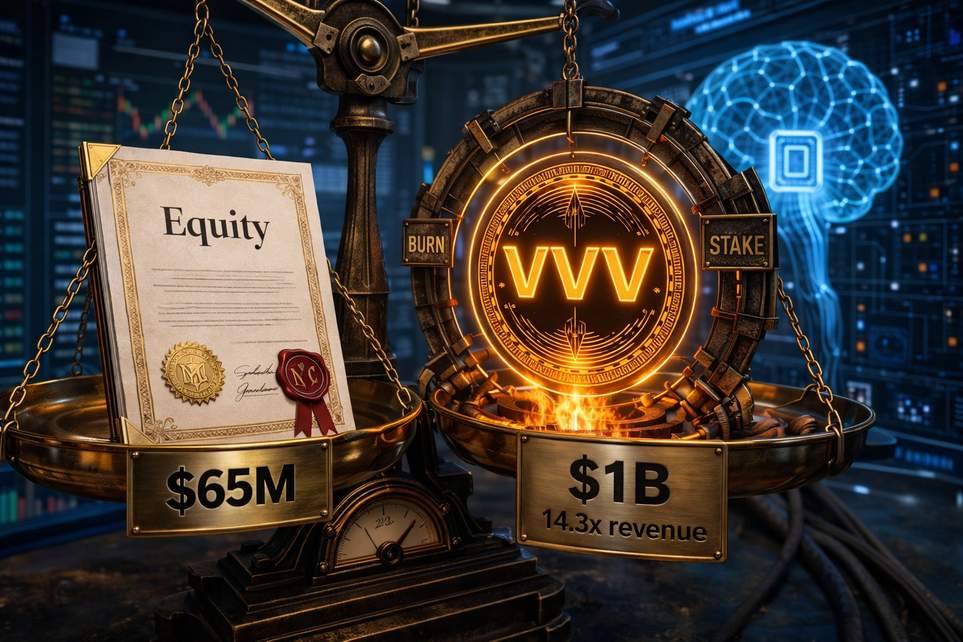
Venice’s $65M Raise: Are VVV Holders Getting the Short End?
The raise: equity first, but tokens didn’t get left out
Venice just closed a $65 million Series A at roughly a $1 billion equity valuation. Instead of funding growth by dumping more of its own token into the market, the company sold shares — but the deal comes with a twist: investors didn’t only get stock. The package included 8.98% of equity, a 1.5 million VVV vesting grant, and warrants to buy another 5 million VVV spread over several years. Big names showed up for the party.
In plain English: Venice decided to raise traditional capital to pay for GPUs and its first data center, but it also handed incoming backers a slice of the token layer. That makes the round a hybrid of legal ownership on one side (shares) and crypto-style exposure on the other (token grants and warrants).
Why VVV holders are squinting at their balances
VVV is sold as a deflationary, platform-linked asset. The protocol burns tokens using platform revenue and handing out DIEM when you stake VVV — DIEM being a daily-dollar credit you can spend on Venice compute. So token owners think VVV is a way to ride Venice’s growth.
Critics point out the difference between two very different kinds of claims: equity comes with legal contracts and enforceable rights; tokens give you economic exposure that only lasts if the company keeps operating the burn-and-stake program. That’s the heart of the gripe. If most of the upside ends up in the equity bucket, token holders might be left with an access token rather than a slice of enterprise value.
On the other hand, Venice says it still holds a big chunk of VVV — more than anyone else — and the team hasn’t been selling during this year’s rally. The company’s plan to build its own compute hardware and a data center could push margins higher, which would, in theory, free up more cash for token buybacks and burns.
Numbers that matter (quick and dirty)
Some headline math so you can judge the drama: Venice’s $1 billion equity valuation is about a 14.3x multiple of a roughly $70 million annual revenue run rate. VVV trades around $13.55, which puts its market cap near $637 million and its fully diluted value near $1.54 billion — roughly 9.1x and 22.1x revenue, respectively.
How many tokens would burns remove? Venice hasn’t published the exact burn percentage, but rough scenarios help. At 5% of annual revenue going to burns, the protocol would retire on the order of a few hundred thousand VVV per year (around 258,000 at current prices); at 10% that rises to about 517,000; at 20% it’s roughly 1.03 million. By contrast, the investor package contains roughly 6.5 million VVV in grants and warrants that will phase in over a lockup and vesting schedule.
Worse-case supply pressure from fully exercised warrants isn’t tiny: if all warrants eventually unlock, that could add a couple million VVV per year at peak cadence. So whether buys-and-burns outpace new token issuances depends on both how aggressively Venice burns and how quickly token grants/warrants unlock into circulation.
The blue-sky outcome: Venice uses the equity money to own hardware fast, margins jump, revenue grows past today’s run rate, burns accelerate, and VVV ends up trading like a credible claim on the company’s expansion. The grim outcome: equity appreciation captures most upside, burns stay modest, and VVV becomes mainly an access-and-staking asset rather than a proxy for enterprise value.
Either way, Venice did the thing crypto projects talk about but often fail to deliver: it built a real product, grew revenue, launched a public token, and then raised outside capital. Now the debate is over how the spoils of future growth get divided — by contract (shares) or by designed token economics (VVV).
Short version: if you hold VVV, watch burns, margin improvements from the new hardware, and the schedule for token grants and warrants. Those three moving parts will tell you whether your tokens get to ride the rocket or just buy you a slice of compute time.
