
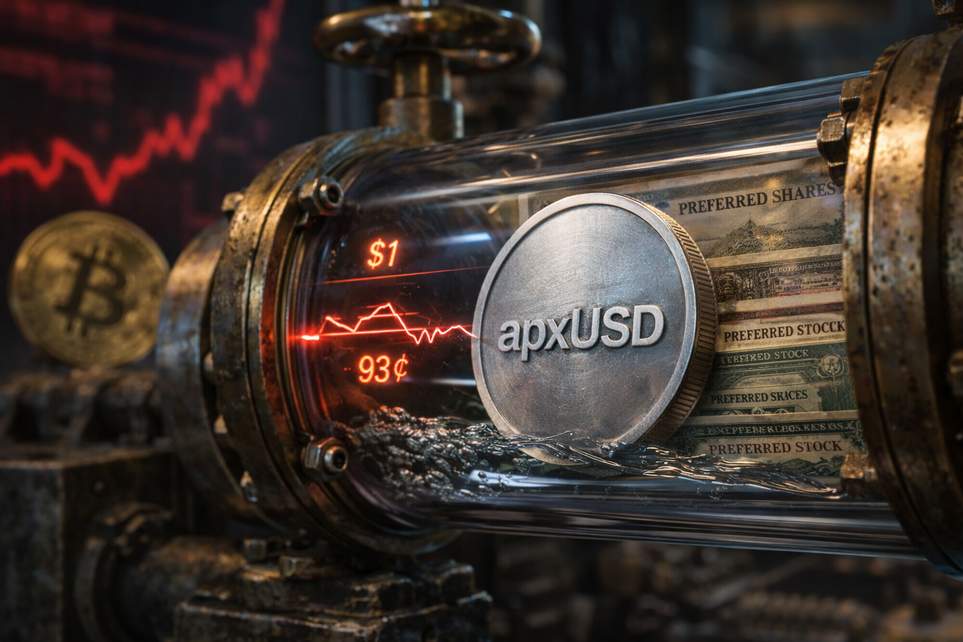
DeFi Dollar Drama: apxUSD’s Dip and the Preferred-Share Plot Twist
The quick version: what happened and why it looks weird
On June 4 a so-called stable-ish token called apxUSD slipped under its $1 reference and briefly traded near $0.93 while Bitcoin was wobbling around $63,000 (down roughly 5.8% over 24 hours). Over the day apxUSD’s price swung between about $0.9094 and $0.9984, trading near $0.9176 at one point, with volume spiking to roughly $74.6 million. That’s not a cataclysmic collapse, but it’s enough to make anyone treating it like plain cash do a double take.
Part of why this felt odd is that apxUSD isn’t backed like your typical cash-stuffed stablecoin. It’s a synthetic dollar whose primary backing is a basket of preferred shares issued by companies that hold crypto — the biggest piece being Strategy’s perpetual preferred stock called STRC. STRC is built around a $100 stated amount and pays a variable dividend (the rate was set at 11.50% recently), which is designed to nudge the market toward par. The protocol also layers in overcollateralization, cash/treasury buffers, arbitrage mechanics, and potential hedges — but the core collateral can still trade like public preferred equity, which behaves differently than plain cash or treasuries.
Why this actually matters (short version: risk, liquidity, and the exit door)
Here’s the punchline: when a DeFi dollar leans on a publicly traded preferred share, it inherits more than yield. It brings credit risk, market-price volatility, liquidity quirks, and awkward exit mechanics. Minting and redemptions for the underlying asset tend to be restricted to authorized institutional participants, while everyday holders rely on market routes — DEX pools, exchange order books, or other DeFi paths. That means if liquidity thins or a lot of users try to leave at once, slippage and haircuts can show up fast.
Concrete plumbing matters. At the time of the wobble, on-chain exposure to apxUSD was concentrated in a couple of places: Pendle accounted for a big chunk of active DeFi TVL (around $118.22 million and roughly 64.6% of listed active TVL), and Curve held about $44.63 million (around 24.4%). The Curve apxUSD/USDC pair was the most traded market with about $48.5 million of 24-hour volume, while another lending venue held only a small slice. Those venue-level realities are what turn a 93-cent print into real-world pain: pool balances change, slippage rises, fixed-yield assumptions wobble, and lending markets can flip price moves into collateral stress.
So what to watch next? A few signals will tell the tale: whether STRC trades back toward par, how much actual cash and treasuries remain in the reserve buffer, apxUSD/USDC liquidity depth on major pools, concentrations in Pendle and Curve, any lending collateral hits, and future dividend decisions from the preferred issuer. If STRC recovers and liquidity holds, this will look like a live stress test of an intentionally flexible design. If STRC stays discounted or reserves prove thin, the market may start pricing apxUSD less like a cash-equivalent and more like a credit-linked collateral token — which, spoiler, changes how you treat it in every DeFi strategy.
In short: clever engineering turned a public-market yield stream into a programmable DeFi dollar — and that bridge lets not only the yield but also the credit and liquidity drama walk right across. Keep an eye on the ticker, your favorite pool’s depth, and whether traders can actually exit without tripping an emergency lever. Popcorn optional, vigilance recommended.
