
How Dark Pools Secretly Slurped 15% of Crypto Volume (Sorry, Whale Watchers)
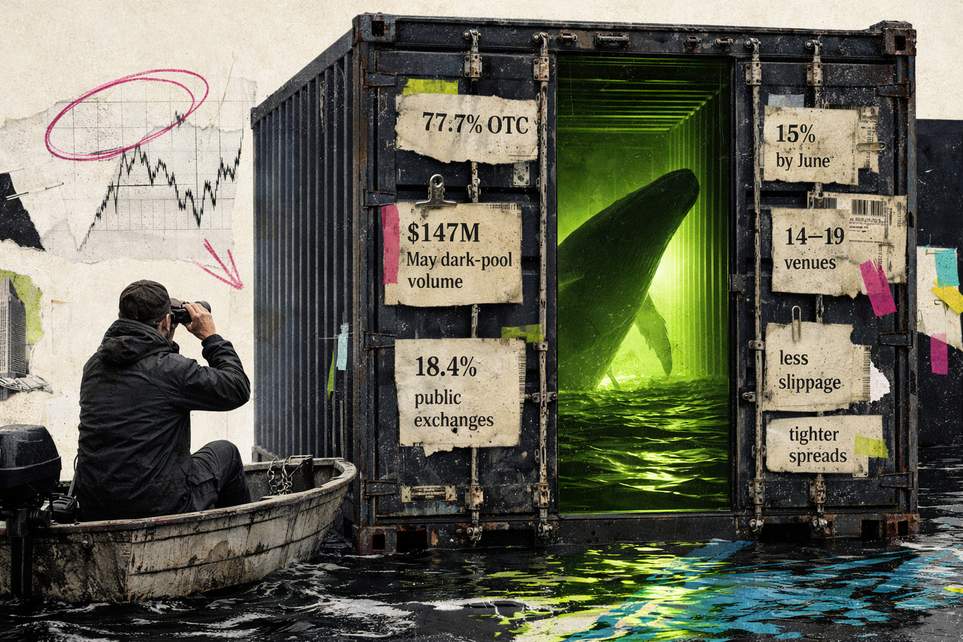
Remember the days when you could stalk exchange order books like a detective and spot a giant whale about to make the market sneeze? Yeah, that hobby just got complicated. In a matter of months, a chunk of crypto trading quietly moved off public books and into shadowy corners — dark pools, OTC desks, and smart routing networks — which swallowed around 15% of monthly volume by June according to one market data provider.
What happened: stealthy execution, but make it institutional
The short version: big players didn’t want their moves broadcast on a single public order book anymore. When a huge order sits in plain sight, other traders can piggyback, front-run, or push the price against it. So brokers and trading platforms began routing large flows through private venues and multi-venue routers that chop orders into tiny bits and scatter them across dozens of destinations.
Anecdotal platform data shows dark-pool execution went from nearly nothing to roughly 15% of monthly volume in a couple of months, and a big share of institutional flow is now handled via OTC desks rather than landing straight on public exchanges. In one month, dark-pool executed trades alone added up to the low hundreds of millions.
Why the switch? It’s the same playbook equities and FX used years ago: stay unreadable. Firms that don’t want their intentions telegraphed to everyone else route trades through desks that absorb size and drip-feed it to exchanges, so the public books barely notice. The hoped-for result: deeper books and tighter spreads when the pieces finally touch public venues.
Why it matters — the good, the bad, and the stuff you should actually do
Good news first: if this works as advertised, most market shocks from single whale trades should become rarer. Aggregators and brokers shopping for execution across venues can tighten spreads and cut slippage for large accounts. That makes trading overall smoother and, ironically, calmer.
Bad news: the visible order book becomes less of a truth serum. Retail traders lose the simple read of “who’s buying, who’s selling.” The directional clues that used to live on public books — big deposits, fat order walls, on-chain blips — get dulled or vanish entirely. That means the old hobby of whale-watching turns into guesswork.
There’s a middle path: on-chain and DeFi venues remain places where big positions can still be seen, so volatility hunters aren’t entirely out of options. But if private execution benefits arrive slower than the disappearance of transparency, ordinary accounts could end up with worse outcomes while the big players enjoy better routing and lower costs.
Practical tips for not being blindsided:
– Treat a single exchange’s volume as just a slice of the market, not the whole pie.
– When possible, compare total execution cost across venues instead of trusting headline fees.
– Use limit orders if a book looks thin — a market order can still drive the price more than you want.
Bottom line: crypto trading is maturing into something easier to trade but harder to read. Retail traders will see fewer headline-grabbing whale runs, but they’ll also lose much of the open-market intelligence that once made those runs predictable. Adapt your toolkit, and maybe give whale-watching a nice retirement party — it was fun while it lasted.
