
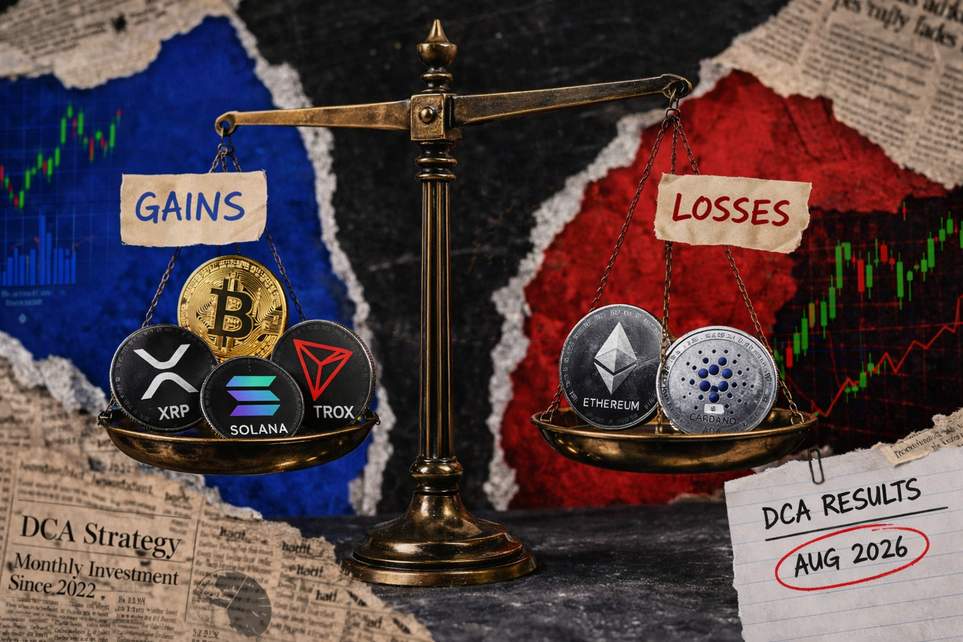
DCA Drama: Why Bitcoin, XRP, Solana and Tron Outpaced Ethereum and Cardano Since 2022
Quick take: the numbers that make you go “huh”
Here’s the short, deliciously awkward version: if someone shoved $100 into a handful of crypto every month from January 2022 through August 2026, the results would look wildly different depending on which coin they picked.
Investing $100 monthly for that span added up to $5,600 per asset. For Ethereum that pot ended up around $4,898 — a 12.5% loss. Cardano was worse: roughly $2,616, a brutal 53.3% drop. Meanwhile, Tron’s TRX turned the same steady grind into about $16,521 (a wild ~195% gain). Bitcoin, XRP and Solana landed in the same pleasant neighborhood, finishing around $8,660, $8,465 and $8,025 respectively — all comfortably positive, up by more than 40% for some.
How the ride unfolded (rallies, meltdowns and plot twists)
Dollar-cost averaging (DCA) — the classic buy-the-dip habit of dropping the same cash in every month — softened some painful entry prices but did not magically guarantee profits. The strategy shines when prices crater and later rebound strongly, because the fixed monthly amount buys more coins during the cheap times.
Case in point: the big 2024 rally. Portfolios that had been quietly accumulating since 2022 saw major gains by the end of 2024. By that holiday-season glow, hypothetical balances looked something like: Solana at about $17,728, XRP at $14,345, Bitcoin around $10,193 and Cardano near $7,251.
That rally wasn’t just technical chart vibes — broader market changes and policy shifts nudged things higher. ETF-style products and other institutional channels opened doors for bigger pools of capital, and political shifts that signaled friendlier regulation also helped push prices up for a while.
But markets are moodier than a cat. After the 2024 highs, a downturn wiped a chunk of those gains. Solana fell from its $17,728 peak to about $8,025 by August 2026, losing nearly 55% of the value an investor had seen at the end of 2024. XRP and Cardano also backtracked significantly, and Ethereum’s DCA stack peaked in 2025 near $6,501 before sliding down to $4,898 — below the $5,600 total invested.
Bitcoin showed a bit more bounce resilience: it climbed past $10k for a time in 2025 before settling near $8,660 in 2026. Tron, however, was the oddball hero: its DCA portfolio rose every single year in this period, from about $1,000 in 2022 to roughly $16,521 by August 2026.
Takeaways (the DCA reality check)
So what’s the moral of this financial sitcom? A few blunt-and-honest lessons:
– DCA reduces the pain of bad timing. If you bought a bunch of crypto near the 2022 highs, continuing to buy monthly saved you from sitting on the full sting of that entry.
– DCA isn’t a guarantee. If the asset never recovers, regular buys just average you into a losing position.
– DCA shines when prices collapse and later roar back. Solana’s bounce made a lot of DCA investors smile. Conversely, an asset that mostly climbs without big dips (like TRX over this stretch) means DCA captures less explosive upside than a single early lump-sum buy would have.
– Diversify and don’t treat DCA like a cheat code. It’s a smoothing tool, not a crystal ball. Keep expectations realistic, spread risk, and remember: past math doesn’t promise future results.
Bottom line: if you enjoy routine, stress-reducing investing and don’t expect miracles, DCA can be a sensible approach. If you like fireworks and fondly remember 300% gains, maybe combine strategies — and always do your own homework before tossing cash into the crypto ring.
