
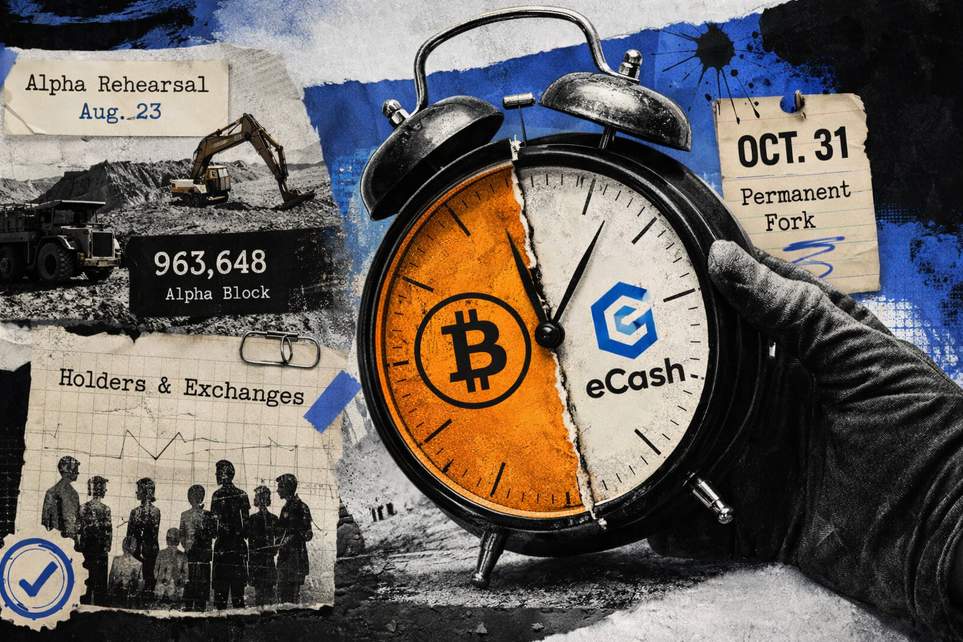
eCash Test Chain Kicks Off — Bitcoin Holders Get a Rehearsal, Not a Split
Heads up: an eCash test chain started producing blocks on Aug. 23, but it wasn’t the permanent copy-paste of Bitcoin people feared. Think of it like a dress rehearsal — flashy lights, a few stage flubs, and no curtain call yet.
Alpha arrived, but it was practice — not the real thing
The project launched an Alpha chain that began at block height 963,648. The network showed activity for a few blocks and even had a stale competing block at the start, which is exactly the sort of thing you expect from a brand-new test environment — messy and experimental, not production-ready.
Crucially, the Alpha run created practice tokens (pECX), not a permanent new asset. The team says those practice units can be exchanged for real ECX when Mainnet goes live. One public comment from the project’s founder suggested an exchange rate of 1,000 pECX for 10 ECX, but that’s a bridge to be crossed later — Alpha transaction history and balances do not automatically become the final ledger.
The Bitcoin ledger itself remained untouched and continued producing its own blocks independently. In short: two chains were running side-by-side for testing, not replacing one another.
Why holders, miners and exchanges should stay calm (but stay alert)
The rollout is staged: Alpha (the recent test), a Beta window expected later, and a planned Mainnet cutover at a specified future block on Oct. 31. Alpha and Beta are explicitly labeled as practice phases that mint pECX rather than a permanent 1:1 copy of Bitcoin balances.
Integration documentation is still in pre-launch shape — some files and guides still reference dry-run parameters and state that final fork hashes, software tags, and replay-protection details will be published closer to Mainnet. For example, current coin-splitting notes mention an opt-in nLockTime value of 499999999 for ECX transactions, but integrators are warned to confirm the final scheme before launch.
Most exchanges and custodians treated the Alpha like a test too: they generally kept Bitcoin services operating, some explicitly said they would not handle pECX or ECX during Alpha and Beta, and others left future handling decisions open. That approach kept BTC ownership stable while giving operators a sandbox to prepare.
So: minor disruption, useful testing, no immediate new asset in your wallet unless you explicitly claim test tokens. The real checkpoint to watch is the Mainnet target date — that’s when practice could turn into something permanent, depending on final code, replay protections, and exchange support.
Bottom line: breathe easy, but bookmark that Oct. 31 target and keep your software and custodial arrangements up to date. Rehearsals are for performers — but the opening night is what really matters.
