
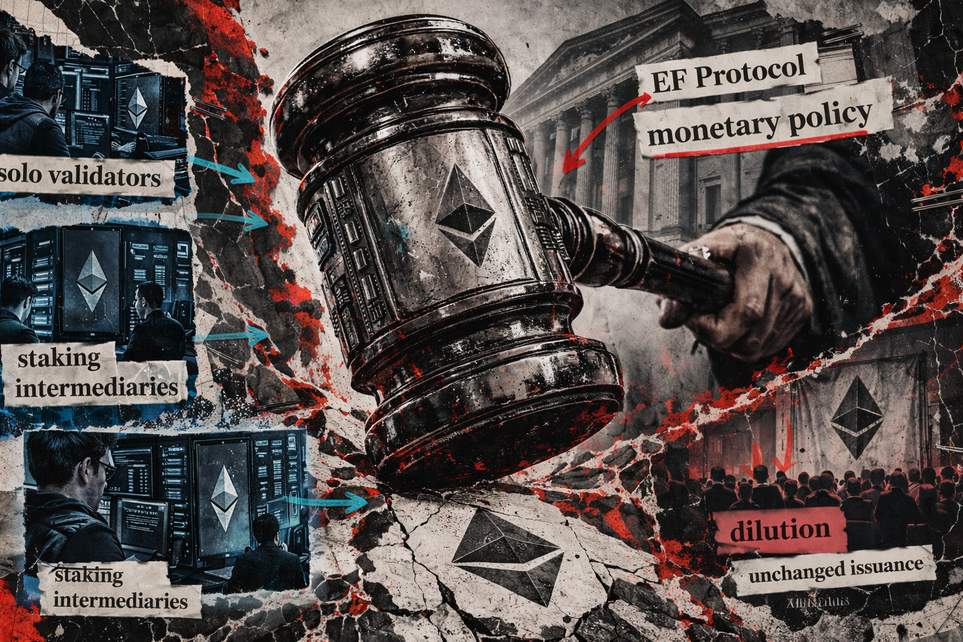
The ETH Supply Showdown: Staking Yields vs. Your Share of ETH
What’s the fuss? Quick snapshot
There’s a low-key drama unfolding in Ethereum land: do we keep paying high staking rewards (sweet for validators) or cut issuance to protect the percentage of ETH that everyone else owns? The protocol team in charge of core upgrades has basically shrugged and said: this is not just their call — the whole ecosystem needs to weigh in.
Here are the concrete facts that make this more than internet theatre. Total supply used as a reference in the examples below is 122.03 million ETH. Roughly 42.9 million ETH (about 35.13% of that supply) is actively staked, and about 1,975,361 ETH is waiting in the entry queue with roughly a 34-day activation time. Those are the starting blocks for the policy math — rough dashboards, not crystal-clear precision.
The proposed cut: how it would work (and what the numbers mean)
The draft proposal under discussion would take a slice of the issuance that normally goes to validators and burn it. The idea: less new ETH hitting the market means less dilution for holders who aren’t staking. The proposal uses a fixed “saturation” balance of 60.25 million ETH as a kind of target where issuance would be fully offset; that threshold is a fixed number, so its percentage of total supply can drift over time.
The transition plan in the draft is not abrupt. It temporarily bumps a base reward factor up (doubling it for a short period) and then slowly brings it back down over roughly 18 months. That eases the shock so rewards don’t collapse overnight. Importantly, rewards from MEV and execution priority fees would not be part of the burn—this targets the issuance slice of validator pay only.
Using the draft formulas and the 122.03M supply reference, and assuming perfect participation and constant active balances (i.e., simplified examples that ignore compounding, fee burn, execution income, costs and penalties), here are illustrative outcomes:
– Under the current reward curve at ~35% stake, total issuance across a year would be roughly 1.086 million ETH. That would translate to an unstaked holder seeing their percentage share of total supply shrink by about 0.88% over the year (before any fee-burn offsets).
– A single 32-ETH validator, under the current system and before expenses or penalties, would earn around 0.81 ETH in annual consensus rewards in that scenario.
– With the draft burn and the transition mechanics, consensus APRs would start lower than today and fall further as the transition completes. In the illustrative 35% case, consensus APR might begin near ~2.05% and settle around ~1.03% after the transition—compared with about ~2.54% under the present formula. That would mean a 32-ETH validator’s pure consensus reward could drop to roughly 0.33 ETH annually after the change, holding stake constant to isolate policy effects. Real-world responses (people adding or removing stake) could alter these outcomes.
Why this is trickier than it sounds — politics, economics, and who counts
Arguments in favor of trimming issuance are straightforward: less new ETH issued = less dilution for holders, and smaller dilution might sound like a win for anyone clinging to a fixed number of tokens. Proponents also say that if staking rewards stay high, more people will hand their keys to custodians and big staking services, which could concentrate control.
But the critics have a point, too. Cutting validator pay could make running small, independent validators less viable. If solo operators get squeezed out, concentration could actually increase because large providers can spread costs across many validators. To figure out which path is likelier, you need real data on operator costs and business models — not just the headline reward numbers.
Governance complicates things further. Decisions about issuance, security budgets and how to measure operator resilience can’t responsibly be made by just one committee. The documented governance approach for the protocol is off-chain and expects input from holders, node operators, validators, developers and users. That means we need a shared baseline (what is active stake today? how much security does X issuance buy?) and a broad, evidence-based discussion before software is written, tested and activated.
The core team responsible for upgrade scoping has paused on making this its sole priority and has asked for a wider conversation. They’ve scheduled a public Q&A session to air concerns and invited feedback — a sign they want more voices in the room before any activation timeline is set.
Bottom line: until this round of debate ends, the protocol keeps doing what it’s doing now — validators keep receiving issuance to compensate them for consensus duties, and holders who aren’t staking keep the same number of ETH but see their percentage slice of the overall supply fall as issuance continues.
So, whether you’re staking, sitting on your stash, or running nodes in your pajamas, this is one of those messy-but-important moments where numbers, incentives and community choices collide. Keep your ears open and your sense of humor intact — the protocol might change, but drama is reliably inflationary.
