
How Banks Are Cloning Stablecoins Without Giving Up Their Loans
Banks have quietly figured out a way to get the best of both worlds: the shiny, programmable features of stablecoins without actually losing the deposits that fuel their lending business. The trick? A thing called a tokenized deposit — basically a deposit that looks and behaves a bit like a crypto token, but lives on a bank’s balance sheet where the bank can still lend it out.
Tokenized deposits vs. the rest of the dollar-shaped zoo
Think of three ways to make a dollar token: a tokenized deposit, a reserve-backed stablecoin, and an overcollateralized synthetic dollar. To the person holding the token, they can all feel like a dollar. But the drama starts when you ask: who actually owns the risk and who can touch the money?
With a tokenized deposit the cash never leaves the bank’s books. The bank earns the return by lending the money, and whoever holds the token is effectively holding a claim on that bank’s deposit — insurance and all. It’s like putting your wallet on a blockchain but leaving the money in the vault.
A reserve-backed stablecoin, by contrast, moves funds into the issuer’s reserves. The issuer pockets the yield from those reserves, holders shoulder the issuer’s operational and reserve risk, and they generally don’t get a direct claim on the interest the issuer earns. Plus, the deposit-insurance picture is different — holders don’t automatically have a pass-through claim to the same insurance protections as direct bank deposits.
And then there are overcollateralized synthetic dollars: tokens backed by collateral that’s kept separate from the issuer. The protection for holders comes from how big the overcollateralization is and how the custody is arranged. Less drama if the collateral is managed well, more hair-pulling if it isn’t.
Why this matters — spoilers: loans and interest rates
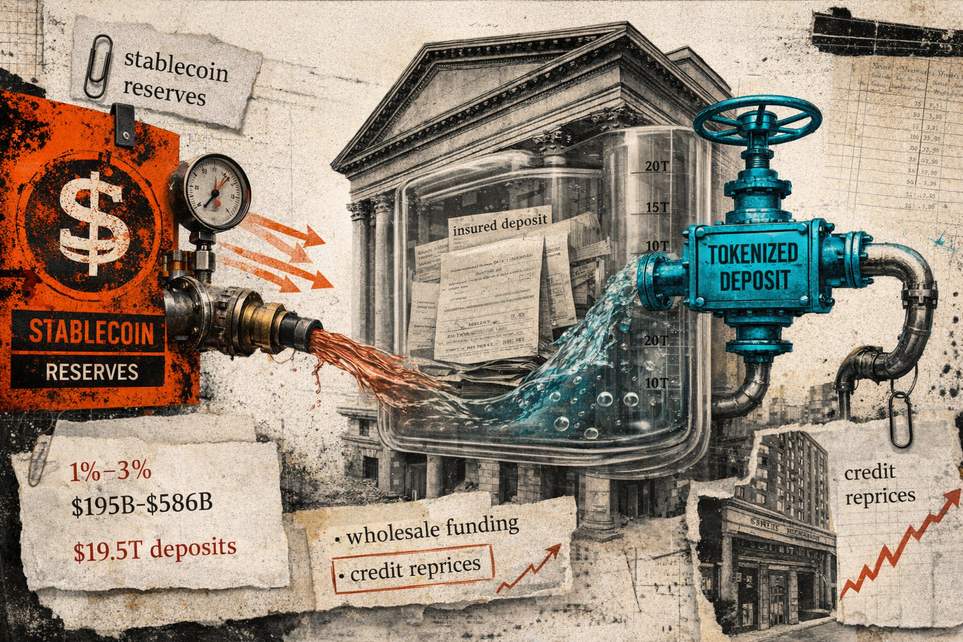
The core issue isn’t fancy tech, it’s the balance sheet. If stablecoins start siphoning deposits away from banks, banks lose their cheapest funding source. That first shows up as higher funding costs because the bank has to replace cheap deposits with pricier wholesale borrowing. Margins get squeezed before you even notice any loans disappearing.
Regulators and central banks have flagged the same mechanism: deposit migration driven by crypto-style products can push up banks’ funding costs and ultimately lead to higher loan prices. In short, the cost of credit is affected by who wins the race to be the cheapest place to park money.
Some big banks are already rolling out tokenized-deposit products — essentially offering programmable, always-on settlement while keeping the deposits under bank oversight. Others are experimenting with token systems that let institutional clients move money on blockchain rails while the underlying balances remain traditional bank deposits.
There are two obvious endgames. The optimistic one: banks build interoperable tokenized-deposit networks that keep corporate cash inside regulated bank rails, giving treasurers programmable settlement without surrendering the funding. The pessimistic one: even a small shift — say 1% to 3% of commercial deposits — could be hundreds of billions of dollars leaving traditional deposits for faster, onchain money, pushing funding costs higher and forcing loan repricing.
Practical takeaway: treasurers and cash managers will probably use both tools—stablecoins when they need money to move fast cross-border or into onchain settlement, and tokenized bank deposits when they want insurance, lending relationships, and the safety of a balance sheet behind their cash.
So yeah, banks didn’t invent a magic coin that beats stablecoins at their own game. They found a way to copy the user-friendly parts while keeping the lending fuel in the vault. It’s a tug-of-war over the cheapest liability in the system, and whoever wins will influence how expensive credit feels downstream. Popcorn, anyone?
