
How OpenAI’s “Luna” Name Turned a Dead Token Into a Two‑Hour YOLO
The five‑minute circus: when product names move markets
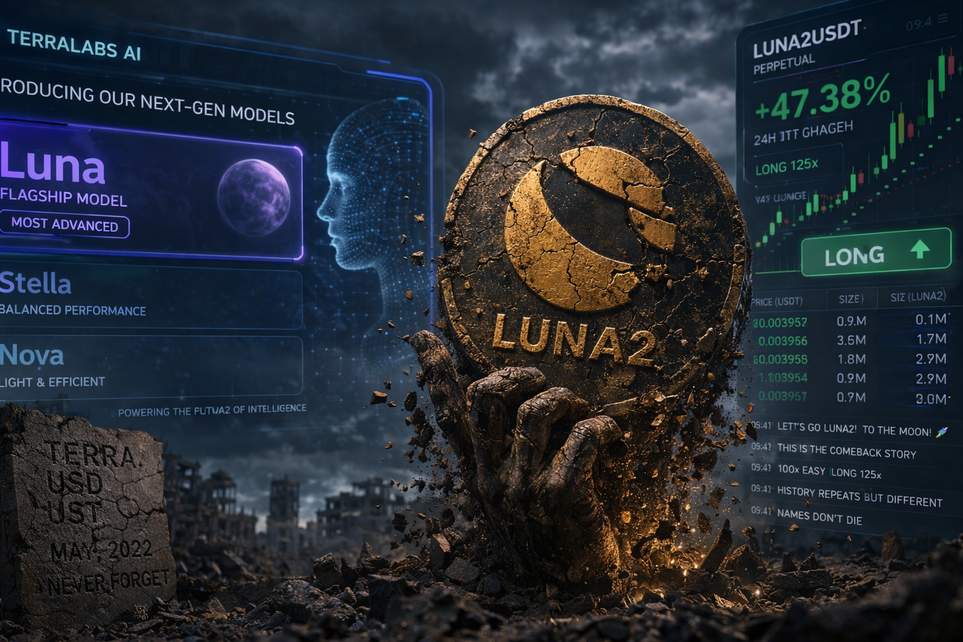
OpenAI quietly rolled out a limited preview of a new model family with three tiers—Sol, Terra, and Luna—and the internet did what the internet does best: misread the memo and sprinted toward the punchline. Within minutes the name “Luna” lit a fuse under a long-maligned governance token called LUNA2. On a popular perpetual futures board the token’s price ticked up from about $0.0486 to roughly $0.0513, while open interest ballooned from roughly 36.5 million contracts to about 52.3 million — roughly a 43% jump. Funding briefly flipped positive at tiny fractions. Spot markets and regulated exchanges mostly sat this one out; the action lived in crypto-native perp venues where thin liquidity makes rapid moves easy.
Why the immediate reaction? LUNA2 is the spiritual heir to a once-famous collapse: Terra’s meltdown in May 2022 erased about $50 billion in market value and left the token with massive cultural baggage. A resurrected governance token bearing the same syllable now sits on dozens of listings but with light liquidity and a modest market cap (around the tens of millions) and single-digit millions in daily volume. When a giant AI company says the word “Luna,” bots, scalp traders, and headline hunters all see an easy meme-shaped joust between a word and a ticker.
Semantic arbitrage: betting on attention, not fundamentals
Call it semantic arbitrage: buying the idea that a recognizable word will ricochet through crypto’s attention economy fast enough to make money before the joke fizzles. This isn’t new—memes and celebrity mentions have been market fuel for years—but it’s getting more mechanical. Projects named after politicians, animals, or single words have spiked hard when a trending post or press release bumped the keyword into millions of feeds. Examples aren’t shy: a token tied to a high‑profile political name surged over 50% on an event, another token tied to a presidential image reportedly jumped several hundred percent after a viral post, and a one‑word post by a major tech celebrity produced moves north of 500% for a tiny token with perp access.
Infrastructure plays its part. A recent academic look at Solana launchpads found tens of thousands of migrated tokens and hundreds of millions of follow‑on transactions—evidence that the plumbing for turning cultural noise into tradable assets is already industrialized. On the demand side, traders scan feeds, preposition on thin‑float tickers, and ride the social velocity wave for minutes or hours rather than months.
Two futures present themselves. In the bullish scenario, desks professionalize this as a repeatable strategy: real‑time scanners, prebuilt execution, and playbooks for entering and exiting around product launches, celebrity posts, or speech excerpts. Any word with enough public surface area plus a thin token and perp access becomes fair game for a short, sharp trade.
In the bearish scenario, the trick self‑destructs. Exchanges raise margin requirements on tokens that show suspicious open interest spikes; funding rates spike and squeeze latecomers; and copycats simply get front‑run by faster players. The arbitrage compresses until only whoever owns the quickest pipeline to news and order flow can reliably harvest it.
Either way, the LUNA2 episode is a tidy reminder: in crypto, cultural association often moves faster than fundamentals. Product naming was supposed to be a technical press note. Instead it became a two‑hour YOLO for people who trade attention as if it were an asset class. Funny? Absolutely. Sustainable? That’s a different gamble.
