
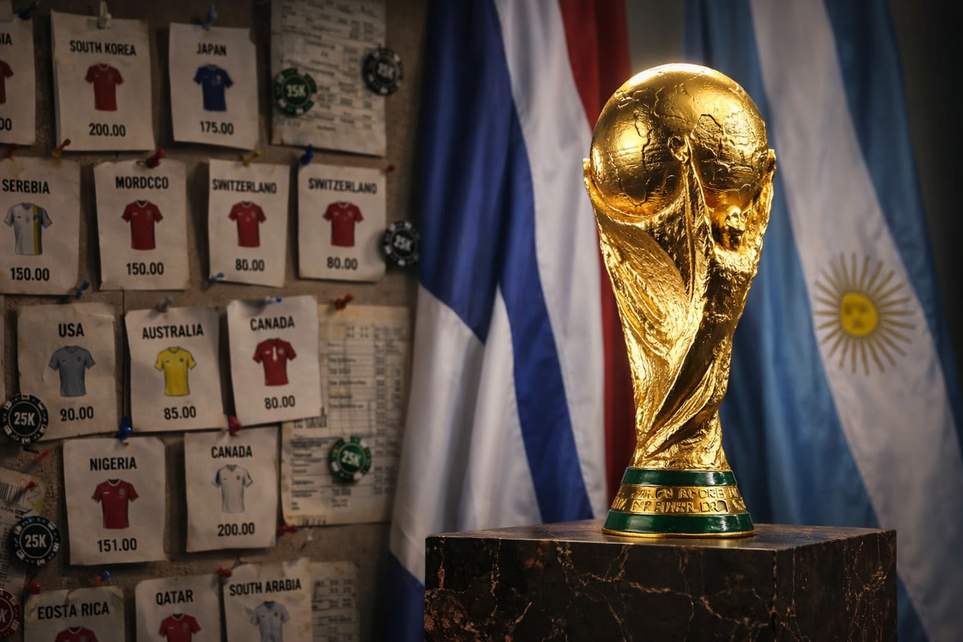
Polymarket’s $3.3B World Cup Frenzy and the Longshot Wormhole
Prediction markets went full-on football (soccer) fiesta this World Cup. Polymarket alone recorded about $3.3 billion in trading tied to the tournament — a number that dwarfs this year’s Super Bowl prediction-market action, which was roughly $1.4 billion. Other platforms saw big action too, but the headline figure hides a goofy little secret: a huge chunk of money is still attached to teams that, according to current prices, have almost no realistic shot at the trophy.
The big numbers (and the weird ones)
At the top of the leaderboard the market is tightly packed: France sits slightly ahead with roughly a 23% implied chance to win, Argentina is right behind at about 21%, Spain around 11%, England near 10%, and Brazil roughly 6%. Those favorites have attracted heavy betting interest — Argentina and France each drew tens of millions in winner-market trading, and Portugal, Spain and England also pulled in strong totals.
Now for the oddball: roughly $1.6 billion has flowed into teams that are priced at a 1% chance or less of lifting the cup. That’s about two-thirds of all winner-market volume. Nations like Ivory Coast, Mexico, Egypt, Cape Verde and Morocco each show unusually large historical turnover despite being priced as longshots. In plain terms, lots of tickets were bought earlier (or held as novelty bets or hedges) and never fully unwound as the odds shifted.
One quick market puzzle sums it up: a combined position across France, Argentina, Spain, England and Portugal costs about $0.72 today and would pay $1 if any of those teams wins. That tells you confidence is concentrated among a few contenders even as billions in past trades sit scattered across outsiders.
Why longshots keep hoarding cash
There are a few reasons money clings to the longshots. First, prediction markets don’t reboot their odds the way sportsbooks often do; a contract stays live until settlement or until someone closes the position, so early trades can become “stale” but still count toward total volume. Second, fan-driven speculation and the emotional thrill of backing an underdog can generate lots of action that isn’t always rationally tied to current probabilities.
Other causes include hedging strategies, multi-leg bets or parlays, and traders who simply forgot to exit. All that leaves a historical footprint: big volume doesn’t always equal present belief in an outcome, it sometimes just shows where traders piled in at earlier stages.
The World Cup spike has also spilled into non-sports bargaining: institutional investors and market-watchers report rising activity in political, economic and other event contracts on various platforms. Some analysts even project total World Cup–related trading could climb much higher over the life of the tournament.
What this means for traders and regulators
For traders, the situation is a reminder to look beyond raw volume and check current prices and liquidity before assuming a market’s sentiment. A line item that sported huge turnover a few weeks ago may now be an orphaned bet paying sentimental value rather than reflecting up-to-the-minute odds.
For the industry, the explosion in activity has drawn increased scrutiny. Regulators are paying closer attention to how these platforms operate, how consumers are protected, and where the boundary sits between regulated event contracts and gambling. That tension is likely to stick around as volumes and interest keep climbing.
Bottom line: the World Cup put prediction markets on the global stage and filled order books, but it also exposed a quirky side effect — lots of historical money still living on improbable tickets. It makes for an entertaining market chart and a useful cautionary tale for anyone who equates big numbers with up-to-the-minute odds.
