
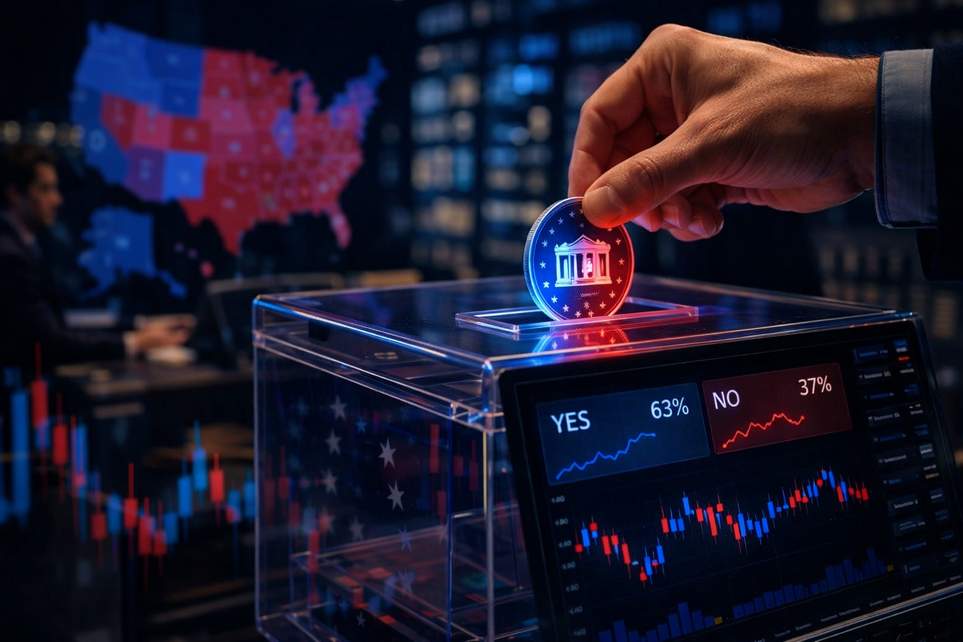
SEC reviews more than 24 ETFs that could bring election betting to brokerage accounts
What’s the deal? SEC and the election-betting ETFs
More than two dozen prediction-market ETF proposals — from firms like Roundhill, Bitwise, and GraniteShares — were filed earlier in the year, but the SEC hasn’t given them the green light. The applications were expected to clear through an automatic window, yet regulators pushed pause to get clearer answers about how the funds would be structured and how investors would be told what they’re actually buying.
These proposed funds would track binary event contracts: think of them as yes-or-no wagers that settle at $1 if the outcome occurs and $0 if it doesn’t. Some of the Roundhill filings focus on 2028 presidential outcomes and control of the Senate and House in 2026. Bitwise matched those and also proposed funds targeting price milestones for Bitcoin, Ethereum, and crude oil in 2026.
In practice, a contract that trades at $0.50 is basically saying the market thinks there’s about a 50% chance of that event happening. Prices bounce with polling, headlines, and whatever Twitter decides to freak out about that week. The ETFs could hold the contracts directly or use swaps tied to them, and the issuers warn the funds could lose everything if the bet goes the wrong way.
Roundhill has a further wrinkle: if a contract trades above 0.995 or below 0.005 for five days straight, the firm can treat the outcome as decided and lock in the gain or loss — then roll into the next election cycle. That sounds tidy on paper, but it also means a fund might exit a position before official results are finalized, and investors might have limited recourse if the market called it wrong.
Why this matters — and why it’s kind of a regulatory soap opera
Putting event-contract exposure into an ETF would drop these binary bets into the same brokerage accounts where people hold stocks, index funds, and retirement assets. Platforms already let traders access event contracts, but an ETF would add the distribution and convenience of the normal ETF world — apps, IRAs, and the “buy” button you tap without thinking.
Prediction-market trading has seen huge bursts of activity: one combined platform tally peaked at nearly $13.7 billion in a single month in mid-2026, driven by big global events. If only a sliver of that activity migrates into regulated ETFs — even 1% or 10% — you’re suddenly talking about billions of dollars flowing into this niche. By comparison, total U.S. ETF assets are in the trillions, so even tiny percentage moves can create a very large new category.
That potential is exactly why the SEC is digging into the wrapper: how these funds are priced, how settlement works, liquidity questions, and whether standard retail disclosures are up to the task for a product that behaves more like a binary derivative than a traditional mutual fund share. The CFTC, which oversees the underlying event contracts, has also signaled concern about manipulation risks, settlement integrity, and the misuse of non-public information, and has proposed updated rules for certain categories of self-certified contracts.
There are two obvious endings. In a bull scenario, approval turns election and threshold-linked funds into liquid, mainstream products — the kind of thing that shows up in casual retirement accounts and gets traded during coffee breaks. In a bear scenario, unresolved risks keep the category confined to specialized platforms, and ETFs never make it onto the everyday shelf.
Either way, regulators face a slightly ridiculous-sounding but very real question: should a fund that can be wiped out by a single yes-or-no outcome sit side-by-side with your diversified, snooze-inducing index funds? The answer will determine whether election betting sneaks into brokerage accounts or stays in the corners of the web where people already place oddball wagers.
Want a short takeaway: exciting, controversial, and probably going to keep headline writers busy for a while. Buckle up — this one’s part finance, part politics, and all kinds of messy fun.
