
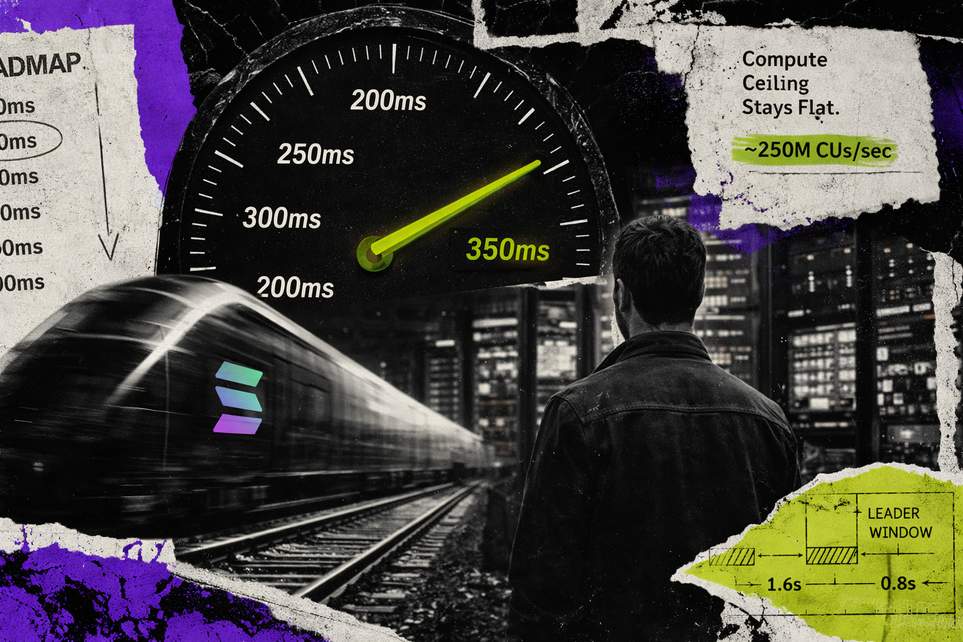
Solana is slashing per-block compute limits so its new 350ms speed boost doesn’t overload the network
Quick TL;DR — what changed and when
Solana is trimming its target slot time from 400 milliseconds down to 350 milliseconds on Mainnet, with the change slated to take effect in epoch 1020. The feature flip already occurred at the start of epoch 1019, but a one-epoch delay means the cluster will only start using the new timing in the following epoch. In plain English: the network will try to make blocks a bit faster, but it won’t suddenly throw more work at validators per second.
The faster stages are being tested on other clusters: one test cluster is already running a much quicker setting, and another test cluster is partway through the staged rollout. The overarching proposal guiding this is currently a draft, so this is more of an experiment-in-progress than a finished speedrun.
Why they’re shrinking slots (and why validators should pay attention)
Shorter slots mean each block has less time to carry work. To avoid quietly doubling validators’ per-second workload, the plan reduces the per-slot compute and resource budgets as slots get shorter. For reference, a block budget that looked like 100 million compute units at a 400ms slot would be adjusted to about 87.5 million at 350ms, 75 million at 300ms, 62.5 million at 250ms, and 50 million at 200ms. Those numbers stack up so that the theoretical ceiling per second stays roughly the same — roughly a quarter-billion compute units per second — even though each individual slot holds less.
Why does that matter? Because limits describe the maximum a block may contain, not what every block will actually contain. Shorter slots change when transactions get their chance to be included and can alter how often validators must hand off responsibility and gossip votes. Solana still gives each leader four slots in a row, so a leader’s window drops from 1.6 seconds at 400ms slots to 0.8 seconds if the network ever goes to 200ms. Less time per leader makes the handoff and propagation dance tighter — blocks must be received, replayed, built on and voted on in a slimmer timeframe.
There are also compatibility wrinkles beyond the validators. Epoch size in slots stays fixed, so epochs simply shrink in wall-clock time as slots speed up: a 432,000-slot epoch is about two days at 400ms but only about one day at 200ms. Off-chain tools that assume a slot equals 400ms (by hard-coding that constant) will get their timing wrong unless they instead read the cluster’s effective parameters. Explorers, RPC clients and apps that estimate elapsed time by multiplying slot counts by 400ms should be updated or they’ll start lying about freshness.
There’s an economic twist too: the proposal ties certain fees to slot timing in a way that preserves a daily target. For example, a proposed validator admission charge in the draft would scale from about 1.6 SOL per epoch at 400ms down to around 0.8 SOL per epoch at 200ms to keep the daily amount roughly steady. It’s worth noting that this fee mechanism isn’t confirmed active on clusters, so the numbers are a plan, not a bill in the mail.
Bottom line: Mainnet’s immediate step is just the 350ms target in epoch 1020 — not a leap straight to the 200ms dream. The whole approach is staged so the network can test coordination and compatibility at each step. The risk is operational: validators and surrounding services must keep their timing and propagation margins intact as slots shrink, or else the faster clocks will feel more like a pressure cooker than a speed boost.
