
Tokenized Assets Are Booming—So Why Isn’t the Cash Register Ringing?
Numbers in brief: growth without the payoff
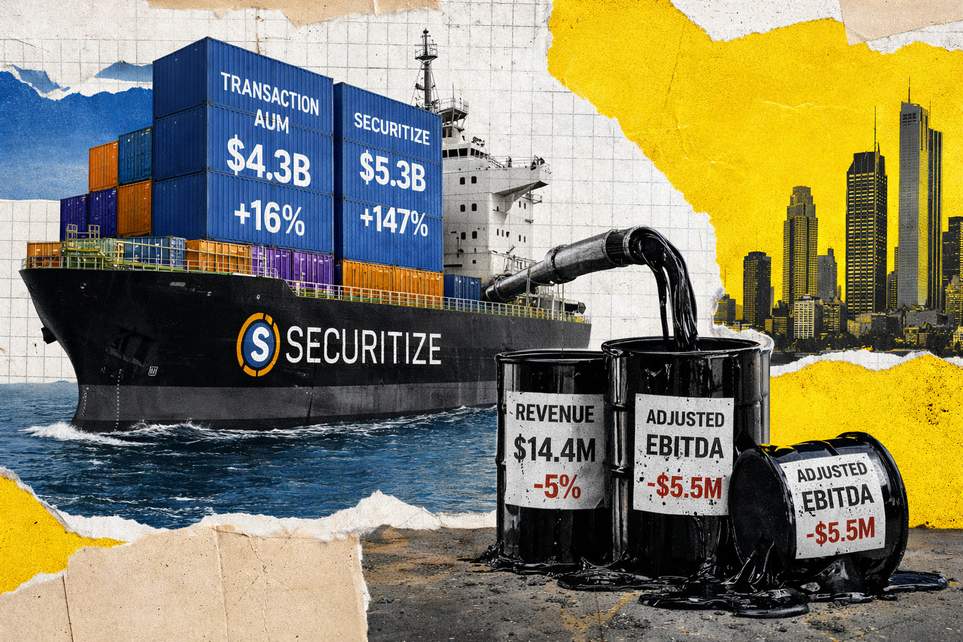
Securitize’s early public-company report looks like a tale of two realities. On the one hand, tokenized assets under management hit a new high at about $4.3 billion (roughly 16% more than a year ago) and platform transaction volume rocketed to about $5.3 billion (up around 147%). Those are headline-grabbing adoption figures—if you like big numbers and catchy charts.
On the other hand, the money showing up on the income statement is… crab-walking. Total revenue slid to roughly $14.4 million (down about 5%), tokenization-specific revenue fell to around $7.8 million (about a 12% drop), and adjusted EBITDA swung into a roughly $5.5 million loss. Recurring asset-servicing fees—think the steady stuff for administering assets on the platform—held up better, inching to about $6.6 million (a small rise).
The company’s earlier projections painted a much rosier picture for the year ahead: a plan that assumed roughly $110 million in revenue for 2026 and healthy EBITDA. Management now guides lower—about $70–80 million for the full year—after reporting roughly $33.9 million in the first half. That math means the second half must crank out something like $18–23 million each quarter to hit guidance, and hitting that original $110 million target would require an even bigger leap—roughly $38 million per quarter, which is more than twice what the company took in this past quarter.
The catch: implementation work vs. durable infrastructure
Here’s where the eyebrow-raising business lesson hides: stuffing more assets onto a blockchain doesn’t automatically convert into steady, repeatable fees. A lot of the current revenue in the tokenization world comes from bespoke projects—custom integrations, setup for specific jurisdictions, and professional services for each new issuance. That’s great for one-off wins, terrible for predictable margins.
Put plainly, there are two kinds of revenue here. One-time implementation income pays for getting an asset live on-chain. The other is infrastructure income: ongoing fees for managing that asset year after year—permissions, compliance, reporting, distributions, corporate actions, secondary transfers, and all the boring-but-critical plumbing. The industry needs more of the latter if it wants revenue to scale with AUM.
Industry voices pointed out that the roadmap forward likely runs through standardized, enterprise-grade tooling: repeatable workflows, broad jurisdiction support, and software that treats tokenized instruments like any other piece of business infrastructure. Advisory and professional services will still exist for complicated deals, but the economics will be healthier if the core value sits in scalable infrastructure rather than always in bespoke projects.
There’s a bull case too. If tokenized public equities and higher-velocity instruments become a bigger slice of the mix, transaction fees tied to trading-like activity could start to matter more—think issuer-sponsored tokenized shares, broker-dealer rails, and fast settlement features that generate fee-bearing volume. That’s a medium- to long-term pivot, though, not a flick-the-switch solution for this quarter’s numbers.
And the risk is clear: AUM and transaction volume may keep climbing while the business sticks to project-by-project economics, leaving revenue noisy and margin expansion very slow. In that scenario, headline adoption metrics look great while the P&L stays stubbornly unimpressive.
Bottom line: the next big test for tokenization is not a new billion in AUM or another billion in transactions. It’s whether those increases start to produce recurring, repeatable revenue that scales on its own. Until that happens, growth metrics will keep dazzling, and the income statement will keep asking for its due.
