
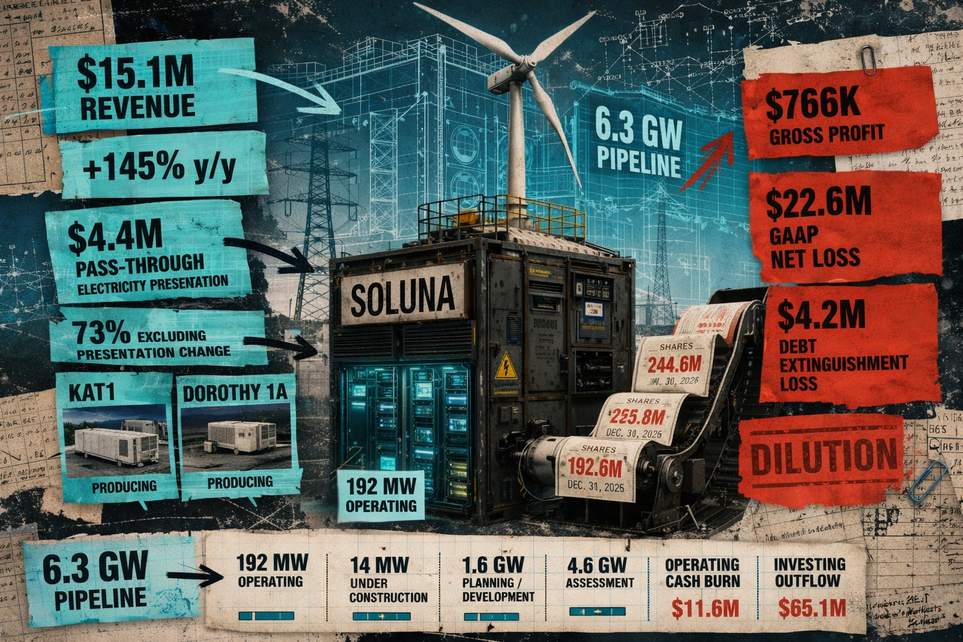
Soluna has 6.3 GW of data center projects on paper, only 192 MW are operating
Quarterly snapshot: revenue popped, profit took a nap
Soluna reported a noticeable jump in revenue—$15.1 million for the quarter, which is way up from roughly $6.2 million the year before. Part of that bump came from a bookkeeping tweak that added $4.4 million of pass-through electricity to both revenue and cost of revenue, which cancelled itself out for profit purposes. Even ignoring that accounting change, top-line sales still climbed a solid amount.
On the project front, Kati 1 finished construction on 48 MW and posted its first small positive site gross profit. Dorothy 1A also chipped in with a few million in revenue and a tidy (for now) gross profit. Despite those wins, consolidated gross profit actually slid quite a bit versus the prior quarter—mainly because of a handful of one-time and timing items: maintenance at the newly acquired Briscoe wind farm, ramp-up costs at Kati 1, and depreciation expenses that started before sites were pulling in their full revenue.
The big-picture bottom line got worse: GAAP net loss widened versus the prior quarter and the year-ago period. The company also recorded a several-million-dollar loss tied to extinguishing debt, which didn’t help the headline.
Money moves: shares, cash burn, and what they sold to keep building
Soluna leaned heavily on equity to fund operations, acquisitions, and development. The share count more than doubled from late 2025 to mid-2026, rising from about 102.5 million to roughly 225.8 million common shares by June 30. A big chunk of that came from at-the-market (ATM) sales—tens of millions of shares bringing in well over a hundred million dollars—and an additional standby equity program that added more capital.
Cash usage in the first half was concentrated in a few places: operating cash burn, large investing outflows (including the Briscoe purchase), and spending to secure stakes in Dorothy 1A and 1B. Notably, the company later sold another block of ATM shares in August, nudging the outstanding share count even higher.
The pipeline paradox: 6.3 GW planned, 192 MW actually running
This is the part that makes spreadsheets wink: Soluna talks about a pipeline of roughly 6.3 gigawatts, but the reality on the ground is a tiny sliver of that. As of early August, only about 192 MW—around 3% of the total—was actually up and running across three fully energized sites. Another 14 MW was actively under construction at Kati 1, while roughly 1.6 GW was in planning or development and about 4.5 GW remained in earlier-stage assessment with power partners.
Take Kati 2 as an example: the joint venture blueprint calls for a first phase of 100 MW and a later phase of 250 MW, but neither phase is counted as operating capacity today. So, for now, the tangible, revenue-producing base is small—192 MW—and the rest is a future-looking pile of potential that still needs a lot of work, permits, power hookups, and patience.
Bottom line: Soluna is hustling to build a big footprint, and investors are funding the sprint with equity, but most of the headline gigawatts are still dreams-in-progress rather than humming data centers.
