
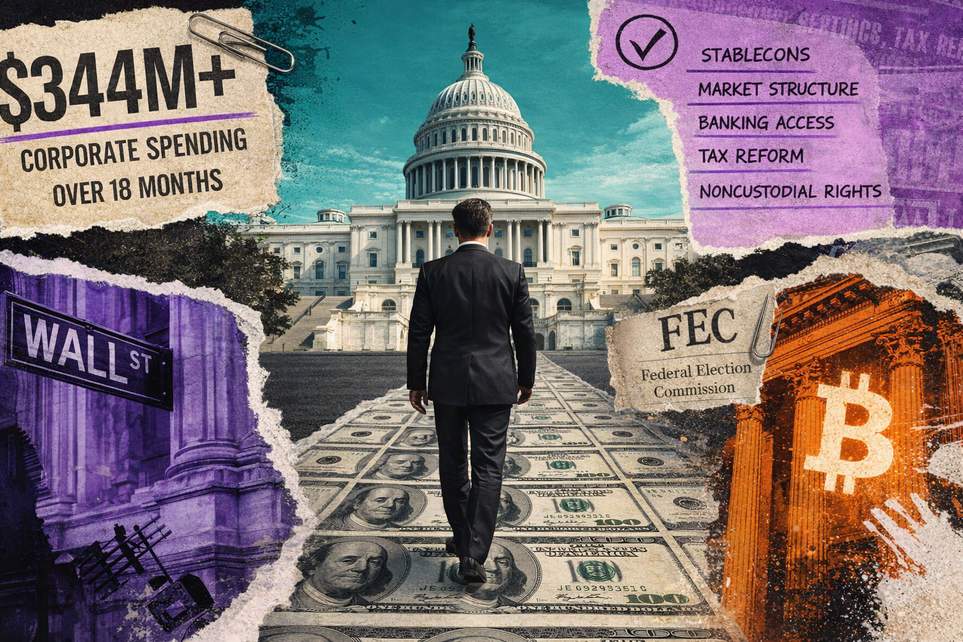
What $344M in crypto political spending is trying to buy from Congress
Big-money alert: corporations poured a record $646 million into political donations over the 18 months through June, and crypto led the parade. The crypto sector alone spent about $206 million, and when you lump crypto, AI, and online betting together you get roughly $344 million — that’s more than half of that corporate haul. Translation: somebody’s lobbying game is very, very strong right now.
Why all this political cash matters
Three years ago the ask was simple: tell us the rules so we can stop getting enforcement letters in the mail. Now the message has morphed into something louder and more permanent — make those rules stick. Founders and investors aren’t interested in regulatory whiplash every time a new administration takes office. They want predictability on timelines of five to ten years, not four-year policy swings.
A few headline developments set the stage. Congress has moved on laws that create a federal framework for payment stablecoins, regulators are rewriting rulebooks, and a Senate cloture vote scheduled for Sept. 15 could decide whether a long-discussed market-structure bill gets a real floor fight. If cloture passes and the legislation becomes law, it would lock in who (and how) certain digital assets are regulated. If it fails, market structure stays the unresolved headline for months — maybe years.
What the industry is actually asking Congress to do
Everyone’s wishlist can be summarized into a few concrete, repeatable asks — think of them as the regulatory equivalents of “more fries, please.” First, finish the market-structure job so SEC and CFTC boundaries are clear and stable; uncertainty is a tax on founders and investors. Second, create practical ways for startups to test new settlement tech without needing the compliance budget of a major bank — regulatory sandboxes or pilot programs, basically.
Third, make banking and payments rails more accessible. Crypto firms want the plumbing commercial banks already enjoy: modernized charters, direct payment-rail access, and the ability to settle without being strangled by state-by-state licensing headaches. They argue that if software coordinates payments without ever holding customer funds, it shouldn’t be forced into 50 different money-transmitter regimes.
Tax rules are another big one. There’s pushback on drafts that would make every tiny automated payment a taxable event. One proposed fix is to treat a year’s worth of micro-payments as a single taxable event so households or devices earning tiny crypto payments aren’t buried in paperwork. And on stablecoins, the message is: rules should be workable for new entrants, not just the big banks that can afford to build compliance moats.
Finally, there’s a push to classify certain tokenized real-world assets — things like renewable energy receipts and other machine-measured outputs — on the commodity side of the ledger so these use cases don’t get tripped up by securities law and can flourish.
Two plausible futures (and why the money matters)
If the Senate clears cloture and Congress turns these bills into law, the industry gets the predictability founders keep obsessing over: capital deploys with less geopolitical/regulatory discounting, startups can plan multi-year product road maps, and the lobbying cash starts to look like it bought permanence rather than just attention.
Fail the cloture vote, or see the bills stall — and the opposite happens. Market structure stays front-and-center, political spending keeps buying headlines but not certainty, and investors keep applying a risk haircut to U.S. crypto policy. In short: either today’s regulatory wins are cemented into law and the next set of fights becomes banking access, tax fixes, and noncustodial protections — or the industry keeps relitigating jurisdiction and who writes the rulebook.
Bottom line: this isn’t just about tweets and court filings. It’s about whether crypto gets a stable seat at the financial table or remains in regulatory limbo. The $344 million shows intent; the Sept. 15 vote and what follows will show whether intent turns into law.
