
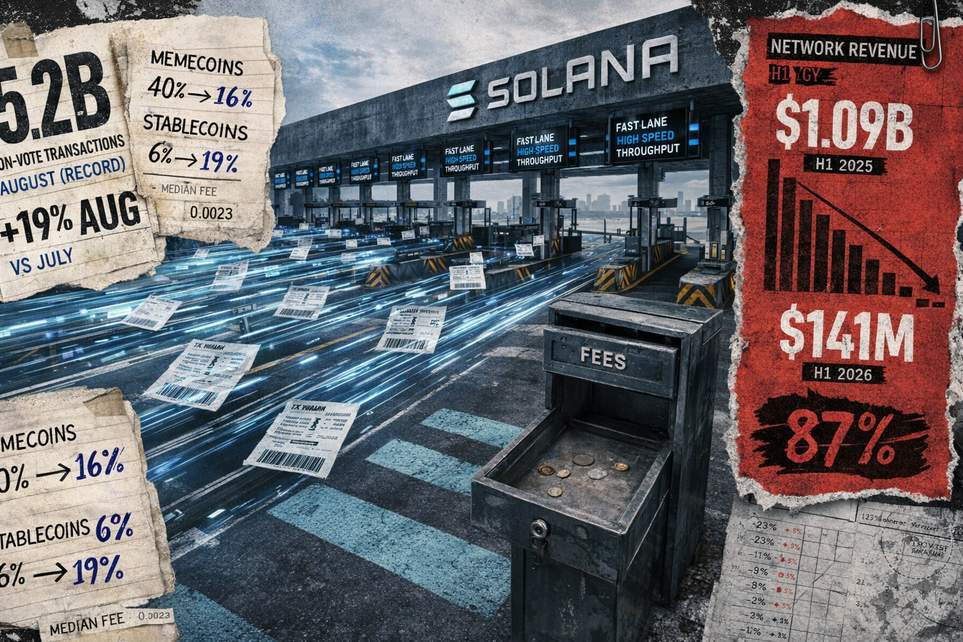
Solana processed 5.2 billion transactions after revenue collapsed 87% – here’s what changed
Traffic went wild, cash did not
In August Solana quietly smashed a throughput record: about 5.2 billion non-vote transactions — roughly 19% more than July. Sounds like a blockbuster, right? But don’t pop the champagne just yet. A separate look at the money side shows gross network revenue for the first half of 2026 plunged to about $141 million, down roughly 87% from the same period a year earlier. In short: tons of action, way less fee income.
Part of the confusion comes from timing and definitions. The 5.2 billion number is a monthly snapshot (August), while the revenue figure covers the six months through June. Also, “non-vote transactions” intentionally ignore consensus chatter from validators to focus on app activity — but that still includes successful and failed attempts, doesn’t count unique users, and says nothing about how much value actually moved. So high transaction counts can look impressive without meaning the treasury’s filling up.
Digging deeper, the makeup of what people traded shifted a lot. A big chunk of the previous revenue came from chaotic memecoin eras when traders were literally paying extra to leapfrog queues. When memecoin trading cooled, so did those high-margin payments. At the same time, stablecoin swaps and other quieter use-cases took a bigger slice of volume — they’re useful, but they don’t generate the same per-trade fees.
Quarterly snapshots echo the trend: one mid-year report put Q2 network revenue near $51 million, a fall from Q1 and far below the year-ago peak, with median transaction fees down to tiny fractions of a dollar. On the other hand, short-term validator fees measured in SOL improved by late August — a seven-day average was materially higher than a few months earlier — which shows there’s some rescue in local fee dynamics, especially if SOL’s price moves around. But SOL-denominated figures and dollar-denominated revenue aren’t apples-to-apples, so tread carefully when comparing.
Fees, tips, and validators — why the money story matters
So why did revenue collapse even as transactions boomed? It boils down to what people were paying for blockspace. Two premium channels — priority fees and extra tipping systems used to game transaction ordering — used to make up most of the high-fee income during the memecoin frenzy. When that frenzy cooled, those big fee streams mostly evaporated.
Under Solana’s fee mechanics the base fee gets split (half to the block producer, half burned) while any priority fee goes straight to the validator that includes the transaction. Validators also have another income source: staking rewards, from which they can take commissions. That means the total payout for validators depends on a handful of moving parts: how many users pay priority fees, how much SOL is burned versus staked, the token price, and whether new steady use-cases keep demand for blockspace high.
In plain terms: a record in raw transactions is good PR and shows the network can handle volume, but it’s not the same as validators or token holders getting richer. If the mix of activity favors low-fee swaps over fee-hungry games and memecoin battles, the network’s throughput and the network’s take can head in opposite directions. The takeaway? Watch both volume and who’s paying for the blocks — the headline number is fun to brag about, but the cash flow is what keeps validators and the economy humming.
