
Bitcoin Clings to $64K as Fed’s Hawkish Shuffle Keeps Traders on Their Toes
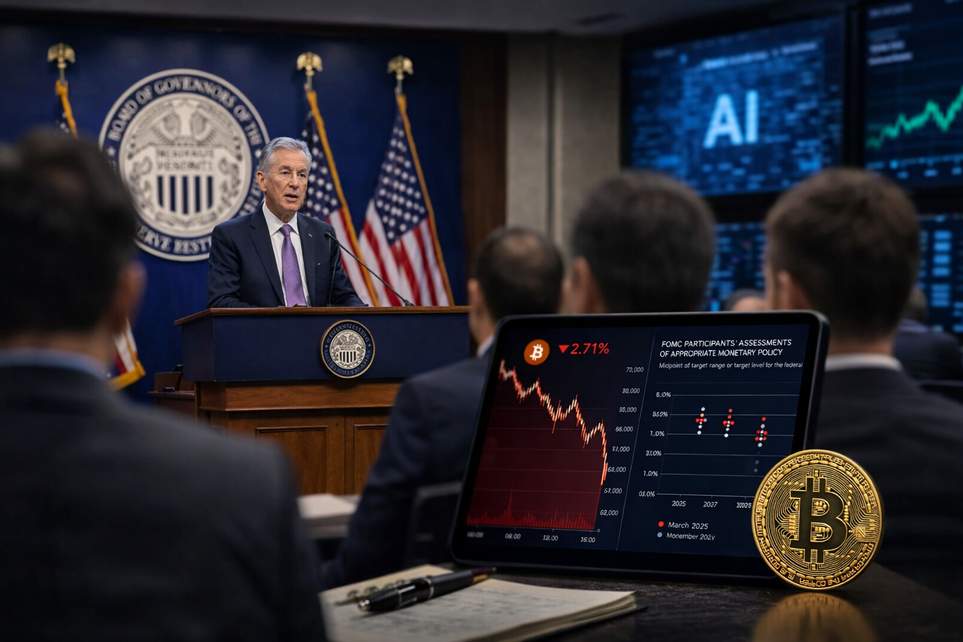
Fed drama + a dash of geopolitics = Bitcoin stuck in the mid-$60Ks. The Federal Reserve kept its policy rate unchanged in mid‑June, but the committee’s outlook shifted hawkish, and Bitcoin slipped roughly 2% into a familiar $64K neighborhood. Traders and algos promptly hit the risk‑off button: stocks and bonds moved lower and yields ticked up, leaving crypto to hold the line and hope for a constructive follow‑through.
Market reaction: Fed U‑turn and the risk‑off shuffle
The central bank didn’t raise rates that day, but the updated projections — the so‑called dot plot — suddenly penciled in a decent chance of at least one hike before year‑end. That change flipped the narrative from “when will the Fed cut?” to “uh oh, maybe more tightening,” and markets reacted accordingly. Bitcoin dipped toward the low $64Ks, while major equity benchmarks slid and the 10‑year Treasury yield climbed toward the mid‑4% range.
Traders quickly priced higher odds of a rate move later this year, and overseas policy shifts added to the jittery mix: another major central bank nudged rates higher just a day earlier, reviving worries about carry trades and capital flows that had been quietly supporting risk assets. Add in the little curiosity that the Fed’s new chair didn’t submit a personal forecast, and you get a whiff of uncertainty that markets don’t like.
What Bitcoin needs to stop wobbling — and why it still feels fragile
Right now the market is treating roughly $64K–$65K like a defensive moat. A clean bullish run would need Bitcoin to break above $70K with conviction, then tackle $75K and potentially test $80K — the same staircase we saw earlier in May. If momentum really returns, bulls talk about a much loftier summer target, but that’s the optimistic path only if a few on‑chain and market signals flip positive.
On the on‑chain side, think of a few headline metrics as checkpoint gates: Bitcoin is trading well below a key long‑term fair value marker (around the high $70Ks), and short‑term holder profit metrics haven’t yet climbed back to breakeven. Recent buyers are still, on average, sitting a bit underwater, which means there’s a pool of sellers waiting near their entry price — not the setup for a furious, smooth rally.
Market structure shows both pros and cons. Bid depth is slowly rebuilding and passive buyers are mopping up supply, options volatility has calmed from its freakout levels, and the volatility risk premium has shifted so that realized volatility now exceeds what options were pricing in. That’s constructive. But dealers have big negative gamma clustered around the high $60Ks, which can act as a magnet for volatility whenever price approaches that region.
So what can break the stalemate? A meaningful easing of hike odds, a de‑escalation in geopolitical tensions, or clear, favorable regulatory moves could give funds the confidence to rotate back into crypto. Absent such catalysts, Bitcoin is likely to chop inside a $60K–$70K band while big money watches IPOs, AI stocks and other flashier opportunities.
In short: Bitcoin isn’t crashing, but it isn’t charging either. It’s in a fragile stabilization phase — bid depth and option markets look healthier than a few weeks ago, but until spot reclaims the cost basis of the most recent buyers and pushes toward that long‑term mean in the high $70Ks, headlines or a policy surprise could still send it spinning one way or the other. Pop some kettle corn and keep an eye on the $70K gate — the next real party starts if that falls.
