
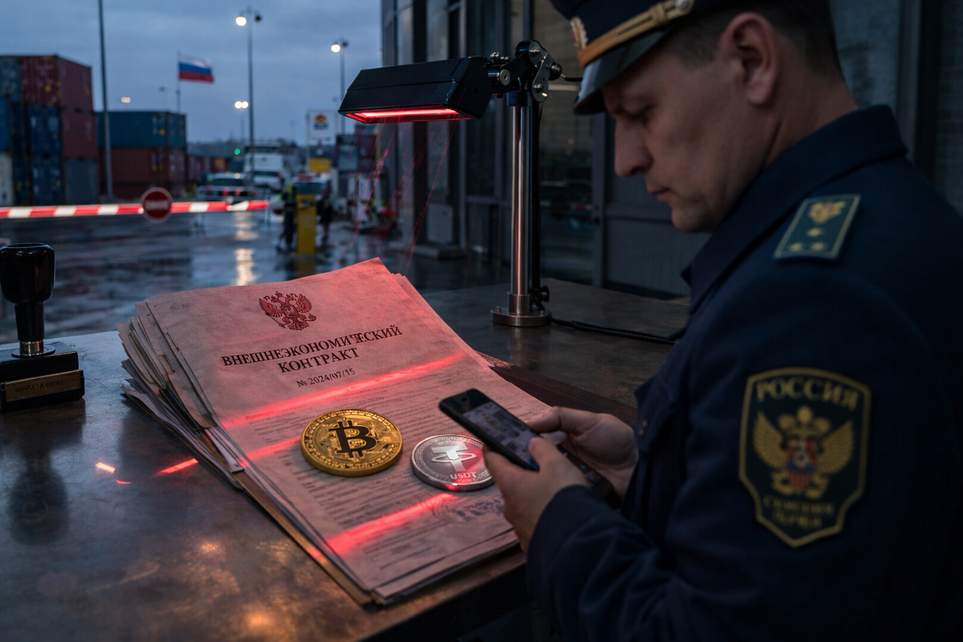
Russia’s Crypto Trade Lab: Legal Corridor, Real-World Roadblocks
So what did Russia actually do?
In plain terms: Moscow has carved out a small, official experiment that lets a handful of exporters and importers settle certain foreign-trade deals using crypto. Think of it as a sandbox with a government guard at the gate — not a free-for-all. The state created a legal corridor that says “yes, but only for selected participants and only under strict experimental rules.”
That sounds bold on paper, but the announcement is mostly about permissioning, not magic. Domestic law can give companies the green light to move value on blockchains inside that corridor. What it can’t instantly rewrite is the rest of the global plumbing: wallets, exchanges, offshore liquidity, custodians, broker desks, and compliance teams that sit outside Russia’s jurisdiction.
Why this is more experiment than escape hatch
Every crypto transfer in international trade needs more than a national stamp of approval. Buyers and sellers must agree on which token pays the invoice, someone has to source and custody the token, and at some point it often needs to be turned into usable money. Those are the spots where sanctions and compliance can trip things up.
If you pick a dollar-linked stablecoin, you invite the issuer and its contracts into the story — and issuers often have clauses and compliance rules that can freeze or restrict usage. Go with Bitcoin and there’s no central issuer to flip a switch, but you still rely on exchanges, custodians, analytics firms, and offramps that can be pressured or blocked. So while the asset layer might look uncensorable, the real-world interfaces rarely are.
That’s the heart of the problem: the corridor is a legal workbench, but the rest of the market decides whether it’s useful. Counterparties and service providers outside Russia must weigh whether touching the corridor is an acceptable compliance risk or a red-flagged detour. If too many of them say “no thanks,” the corridor stays a symbolic policy exercise rather than a thriving payment channel.
What to watch next (aka the boring-but-crucial signals)
If you like detective stories, this one hinges on operational clues rather than press releases. Useful signs the corridor is moving beyond theory would include named participants, repeated settlements that use specific routes, changes at exchanges or OTC desks showing support or bans, visible wallet freezes or issuer actions on stablecoins, and how non-Russian firms update their compliance playbooks.
Absent that evidence, the sensible conclusion is cautious: Russia has created a legal avenue, but turning it into a practical, scalable payments plumbing involves a thousand tiny choke points. Western enforcement guidance expects crypto businesses to screen for sanctioned activity and block forbidden transactions — meaning every service in the payment chain becomes a compliance checkpoint.
Bottom line: this is a neat case study in law-versus-infrastructure. The state can open a legal door, but whether anyone walks through depends on the global network of firms that actually move, hold, and convert crypto. For now it’s less a revolution in global payments and more a carefully supervised experiment with a long to-do list.
