
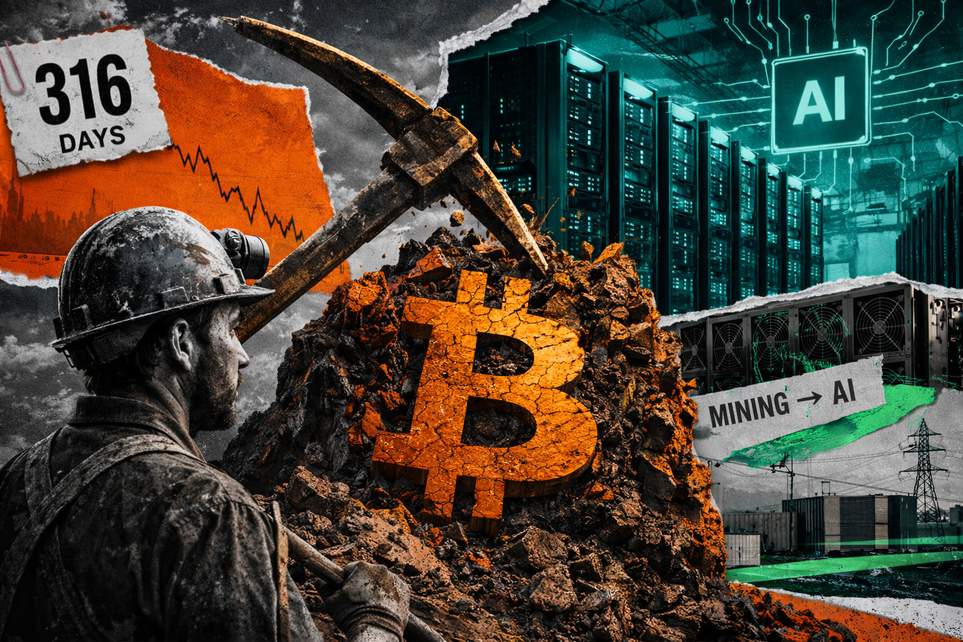
Why Bitcoin’s 316-Day Hashrate Drought Could Be Hard to Reverse Thanks to AI
Bitcoin’s long nap: the numbers and the weird timing
Bitcoin’s mining power has been stuck below its all-time high for 316 days — a major snooze for a network that’s usually more dramatic. As of the end of August the seven‑day average was hovering around 914 exahashes per second, roughly 20.6% shy of the October 2025 peak of about 1,151.6 EH/s. That stretch is the longest lull in over a decade.
You’d normally expect a bounce when prices spike. Bitcoin climbed roughly 35% from late June to late August, even flirting with the low $80k range, but the usual miner response—firing up idle rigs—has been weak. Over the same window network hashrate actually fell by about 10% in one of the few times price and hashrate moved in opposite directions since 2012.
Digging deeper, mining economics are still under pressure. Difficulty has pulled back from its November 2025 high by around 18.3%—the biggest correction since the big shakeout in 2021—and metrics that track miner revenue (think: the Puell Multiple) have been unusually low, pointing to strained margins. Those forces pushed marginal machines offline, which is precisely what Bitcoin’s protocol is built to handle: fewer rigs → lower difficulty → sweeter margins for the survivors.
There were small signs of a rebound in August: a modest difficulty uptick early in the month as hashrate recovered toward the mid‑900s EH/s, followed by another fall later that month that offered fresh relief. By Aug. 31 some trackers showed seven‑day hashrate back around 915 EH/s and hashprice climbing above its month average, which under normal circumstances would make restarting mothballed rigs increasingly attractive.
But wait — AI came for the power, and it might not give it back
Here’s the twist: a chunk of the power and data‑center capacity that used to be “waiting in line” for the next Bitcoin upswing is now being paid to do something else — namely, run AI and high‑performance computing workloads. That changes the comeback story.
Some mining shops have actively decommissioned rigs and repurposed their facilities to host AI clouds and other compute customers. A facility that used to sit idle for a few months hoping for better mining margins might now be under a multi‑year contract with an AI tenant. Power that’s contractually committed or wired into long‑term compute deals doesn’t get pulled back into Bitcoin overnight, even if difficulty drops and BTC price pops.
Seasonal grid curtailments and the retirement of inefficient fleets also played a part in the downturn, but AI is the structural shift that could make this recovery stickier. The space is split: some operators are still adding Bitcoin machines, some are leaning hard into AI, and a few are trying to straddle both worlds. Big, decade‑long compute deals and multiyear electrification plans mean the balance could tip away from pure mining for longer than anyone expected.
So yes, Bitcoin’s automatic balancing mechanisms are still doing their job—blocks are coming near the 10‑minute target and difficulty keeps adjusting—but the 316‑day drought shows that higher prices alone might not be enough to coax every watt back into mining. If the industry can’t reclaim that idle capacity, it may be because that capacity has found a newer, better‑paying home running AI workloads.
In short: expect a more complicated comeback. Bitcoin can incentivize miners to return, but if the electricity and data halls are signed, sealed and delivering machine‑learning results, the mining party might be missing half the guests.
