
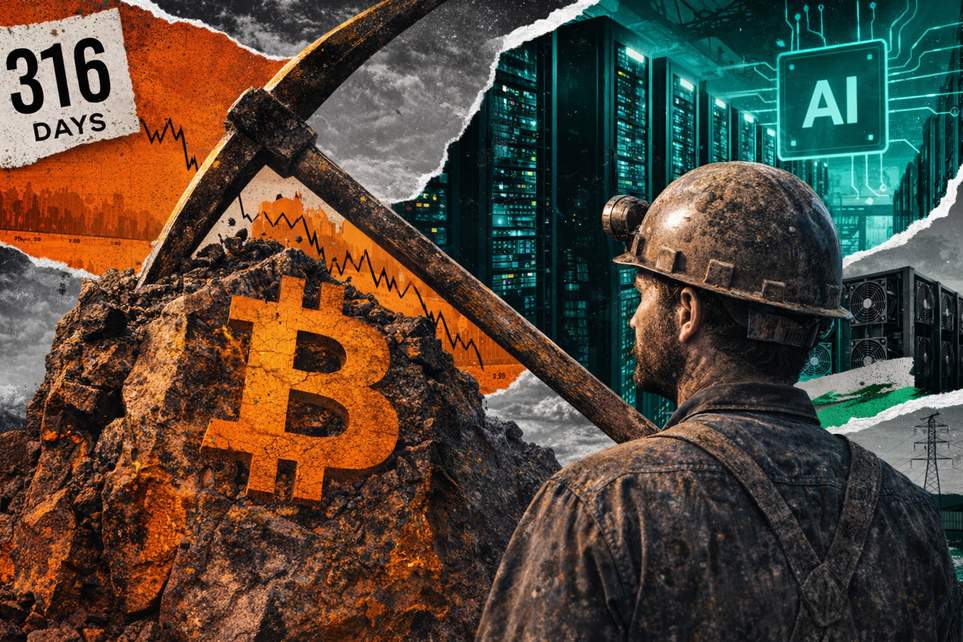
AI Stole the Hashrate? Why Bitcoin’s 316-Day Drought Might Stick Around
Bitcoin’s mining network has been stuck in a weird mood for 316 days: no new seven-day hashrate highs. Think of it like the party that just won’t restart. The seven-day average was hovering around 914 exahashes per second at the end of August — roughly a fifth below the late‑2025 peak — and that stretch without a new high is the longest in about a decade.
What’s actually happening with hashrate and miner economics?
Normally when Bitcoin’s price perks up, miners dust off rigs, flip the power switch and everyone’s back to churning hashes. This time, though, things got weird. Bitcoin rallied hard through the summer, yet the network’s hashrate slipped instead of sprinting back. That mismatch — price bouncing while compute power falls — only shows up rarely in Bitcoin history.
Behind the scenes there are a few nudges and shoves: mining difficulty has dropped meaningfully from last year’s high, miner revenue indicators have been in the low percentiles, and some inefficient or marginal machines were turned off. A couple of small difficulty upticks and then falls in August hinted that the automatic recovery process is doing its job — blocks are still arriving close to the 10‑minute target — but the overall hashrate remains well below its peak.
Practical signals also improved a touch: short-term metrics like hashprice and seven-day averages crept up at times, suggesting some idle units could be coaxed back online. Normally that would be enough to invite a wave of restarts. But this slump feels different, mainly because some of that idle power didn’t just go idle — it got a new job.
Why AI makes bouncing back harder (yes, really)
Mining farms aren’t just rows of noisy boxes — they’re serious power hookups, industrial cooling, and big physical sites. That infrastructure is suddenly very attractive to companies building AI and high‑performance computing centers. Instead of waiting a few weeks or months for mining economics to improve, some operators have repurposed capacity into AI cloud services or long‑term compute deals.
Examples pop up across the industry: some firms cut their self‑mining footprint substantially while powering up AI capacity measured in dozens of megawatts; others reported shifting parts of their data‑center power to high‑performance computing. A few miners even signed multibillion‑dollar, multi‑year compute contracts that basically lock that power away for a long time. When power is contractually committed for years, it can’t sprint back to Bitcoin if prices surge.
That doesn’t mean every miner abandoned ship — some operators are still expanding Bitcoin capacity, and others are trying to split the difference by doing both mining and hosting AI clients. Seasonal grid curtailments and shuttered inefficient rigs also explain part of the downturn. But AI changes the recovery math: restart economics once relied on temporary unprofitability; now some capacity is being permanently reallocated.
Bottom line: Bitcoin’s difficulty algorithm and block schedule are working as designed, and some hashpower is returning. But the unusually long dry spell suggests the classic price-driven bounce might be weaker this time because parts of the fleet found more stable — and sometimes more lucrative — alternatives. The big question now is this: will improving Bitcoin economics lure enough machines back, or has AI offered a better gig that’s here to stay?
